Friday, 23 December 2022

Colombia - Day 1 - Medellin to Jardin

The internal flight from Bogota takes about 35 minutes, although we were probably onboard for double that. My first flight with Avianca, and I was not impressed that the lady opposite me had a rosary and was clearly praying fervently that we were not going to plummet from the sky. Maybe this is a South American thing? 

The birding began immediately, with Blue and White Swallow and Eared Dove seen as we walked to the terminal. We were met by Ernie, a long-time driver for Mannakin, so now we were six up in a smart white minivan. Our first destination was the reserve of La Romera, on the eastern slope of the western cordillera - we crossed Medellin and then climbed for a short while, desperate to be birding after hours of travel. It did not disappoint in the two hours we were there, though looking back a list of 21 birds seems slim, especially as much of what we saw were ABA birds that I didn't need such as Swainson's Thrush, Black-and-White Wabrler and Blackburnian Warbler. Quality not quantity though, with the main endemic target of Red-bellied Grackle and Andean Motmot seen very well. 

Swainson's Thrush


Red-bellied Grackle


Back on the road we stopped for lunch south of Medellin en route to Jardin. Whilst waiting for the food arrive we continued birding; the roadside restaurant was clearly on the birding trail as it had feeders set up next to the tables that attracted various Tanagers, a Buff-throated Saltator, Steely-vented Hummingbird and numerous Acorn Woodpeckers. A Colombian Chachalaca perched in a tree. 

A Colombian street kitchen

Palm Tanager

Blue-grey Tanager

Clay-coloured Thrush

Acorn Woodpecker

Colombian Chachalaca


We continued on to Jardin, arriving late afternoon. The main attraction here is a well-known Cock-of-the-Rock lek, and we went straight there. This for me was a dream bird that for some reason I had thought would be hard - all crazy-looking birds like this are hard to see aren't they? As it turns out they are not hard at all, and we had double figures at point blank range, constantly squabbling and making a massive racket. Wow! The only down-side was the density of the canopy, with the birds almost always in deep shade on a steep south-facing slope. Thank goodness for a) my monopod, and b) the high-ISO capabilities of my trusty old 1DX! Hummingbirds here were Green Hermit, Steely-vented, and Andean Emerald. This close to the equator the days run from 6am to 6pm, and we remained birding here until sunset.


Simply unreal


In the evening we ate pizza on the main square in the party-town of Jardin. It was a long weekend and many people from Medellin and the surrounding areas had arrived to relax. This they did very loudly into the small hours, which given we had a very early start was rather hard going. Still, we were here, we were birding, and promise hung heavy in the air! The following day we were birding the road known as Alto de Ventanas, and the RNA Loro Orejimarillo (the Yellow-eared Parrot Reserve). There were also some Antpitta feeders.....

Basilica Menor de la Inmaculada Concepcion


Thursday, 22 December 2022

Meanwhile in Fife


Life continues apace. I've just spent a few days with my family in Fife in advance of Christmas. Various issues conspired to make my travel as difficult as possible, but I am an old hand at negotiating such trivialities these days. Did I mention that our flight back from Provence was cancelled, the replacement the following morning also cancelled half an hour later, and that we hired a car and drove through the night to Geneva to get home? A bit of snow and a train strike is nothing!

I spent little time birding, but what I did up there was very good indeed. A few days before I got there an immature Lesser Scaup had been found on Kinghorn Loch which is not very far from Central Fife where my parents live. The day after I arrived I nipped down there for an hour. I only had bins, other optics had been sacrificed in favour of Christmas presents, but I found the bird very easily amongst the Tufted Ducks. A drake Ring-necked Duck was on the other side of the loch, and a Kingfisher flew across as I was scanning - all decent county birds.


I also briefly dipped the Stejneger's Scoter at Aberlady bay after taking Mrs L to the airport on Sunday, but I can have no complaints really. I naivley hoped that I would just bowl up and someone would have it in the centre of their scope. No such luck in the two hours I had, but I did see more Fieldfare than I have ever seen in my life, and found a Short-eared Owl in the dunes which my East Lothian list was very pleased with. It was a nice prelude to the football final for which made an uncharacteristic exception.

The real excitement during my visit though was in the garden, which is probably where I spend most time birding whenever I visit. Before work on Tuesday morning I was standing in my favourite skywatching position on the side of the house when my ears registered a harsh squawk. My brain filtered it out immediately and I carried on looking at the sky. Another squawk. This time my brain allowed this to dribble through to my conscious self, and various thoughts started to form. Wait, what? Gah!! It cannot be! And then sure enough a Ring-necked Parakeet flew over the garden and on through the village. Bloody hell! Is nothing sacred? I had noted a very small number of records this year on the Fife News Whatsapp group, but I hadn't really given it much thought. One does not twitch Ring-necked Parakeets if one has any sense of self worth.

Needless to say this was a new bird for the garden, for Fife, and for the whole of Scotland, and I am staggered by it. A lost waif, or the vanguard....? Given the siuation down south I fully expect the latter, which is backed up by the latest eBird distribution map. Oh dear.


Wednesday, 21 December 2022

Colombia. Finally!


It was finally happening. A trip booked in early 2020 for November of that year, cancelled not once but twice by Covid, was finally underway. We were four - Dave, trip organiser, world-birder, lover of 8kg field guides and Antpitta fiend. Richard, world-birder, calm under pressure and neotropical lister. Bob, world-birder, minimalist packer and one-a-minute awful puns. And me, passenger, along for the ride, and will there be Hummingbird feeders?

I travelled alone via Spain, less convenient perhaps but more comfortable, and as a bonus I got an evening eating tapas and a morning birding in Madrid. I would be the only person to see Sardinian Warbler on the trip. I arrived in Bogota a little earlier than the rest of the team, and was met by the father and brother of a Colombian colleague of mine, concerned that I might head out of the wrong door and be gobbled up. These kind people passed me on to Alejandro, our guide for the week, who was waiting at the hotel I had booked for the few hours I was here. I should have just gone to a bar or something, but I guess a few hours sleep were worthwhile at 2500m altitude.

The guys arrived direct from London right on time, and now five we flew the short hop to Medellin on the western side of the central cordillera. The Andes split into three fingers in Colombia, separated east to west by the Magdalena and Cauca valleys. Our trip was centered around the central and western branches, with time on three difference slopes each with different aviafauna. It had been a long time coming and to say we were keen was an understatement.

I would normally write a post about logistics etc, but that is only really meaningful when I have done all the organising. This was a guided trip, and as such the itinerary and logistics were all sorted out by Manakin Tours working with Dave to understand what we wanted to see. Antpittas apparently. My contribution was paying Dave my share of the bill when the time came, an incredible luxury. I could get used to this! 

Nonetheless here is a map of where we went and a rough outline of the days. This was an Andean speciality trip, with almost all birding at high altitude in cloud forest and rainforest habitat on the western and eastern slopes of the central and western cordilleras. My experience of birding in South America is pretty minimal - Costa Rica in 2018 and a wedding in Argentina in 2008. There would be little cross-over and I had high hopes of seeing many many new birds.

Itinerary

Day 1: Bogota to Medellin. La Romera reserve. Drive to Jardin, Cock of the Rock lek.
Day 2: Alto de Ventanas. Antpittas.
Day 3: Across the Cauca Valley to Rio Blanco reserve (Manizales).
Day 4: Rio Blanco reserve. Antpittas.
Day 5: Hacienda el Bosque. Antpittas. The Paramo of Los Nevados.
Day 6: Otun Quimbaya reserve, transfer to Montezuma/Tatama. 
Day 7: Montezuma
Day 8: Montezuma
Day 9: Montezuma, fly from Pereira to Bogota and then home.


In short it was as amazing as we had all hoped, Manakin were great, the timing of everything was spot on, the people on the ground were sensationally organised, including moped lunch deliveries high up mountain tracks. The local guides were really good and the birds mostly behaved impeccably with the notable exceptions of Tapaculos. There is really no point to Tapaculos. Anyway, neotropical birding is the best birding on the planet and since returning I have been having a really hard time trudging around Wanstead seeing nothing whilst being very cold. Day one beckons...

Tuesday, 20 December 2022

Life in the Freezer


This blog and its title don't often see eye to eye these days. I'm aware of this and I don't really mind that much. Hats off to those who continue to write about their local goings on though, I still read a few of them and wish I could diligently do the same. Once upon a time I was right there with them, and maybe one day I will be again, but right now it is hard. Part of it, I am sure, is that I don't take a camera round with me any more, and when I don't have a photo any words I may come up with seem to fall flat. I could take a camera - I have several as regular readers will know - but I just don't enjoy birding locally with a camera as I can't take the kind of photos that I enjoy taking. Yes I could take a photo of Blue Tit with a bunch of twigs around it, on one of which would likely be swinging a small bag of dog shit, but for some reason it just does not appeal, despite the likely positive impact it would have on my creativity. No, these days I much prefer to just have a wander around with bins, seeing what I can see. Readers would of course be forgiven for thinking that I never bird the patch any more but that is simply not true - I have submitted 101 checklists this year so far and there are a few more to come. It is just that I cannot be bothered to write about it very much as I find it essentially impossible to make it sound interesting. Those 101 checklists cover 115 species, including two patch lifers in the form of Merlin and Tree Sparrow. I think I probablty did mention these, but of course those are exceptional events. Most patch visits see a succession of the same birds - as anyone who regularly birds a patch will know, at times you do feel like a broken record, simply going through the motions as the seasons change. I've been here before is a frequent feeling, and I often wonder why I am doing it. Then I remember that the alternative would be to sit indoors being bored and getting even chubbier.


I have no upcoming New Year's resolutions about how I am going to bird Wanstead like never before. Pointless. I am going to do what I enjoy most at the moment, which is a bit of everything and a fair amount of travel. It will therefore perhaps not surprise you to hear that I am writing this not from Wanstead but from Scotland, where I am passing a few days in a warm house with an Aga. My parent are old and both need and can afford to pay for heating. They are very lucky, and so I am to be here - my own house in Wanstead is basically a fridge for large parts of the day. We can also afford heating but we prefer to use it sparingly for all sorts of reasons. I missed most of the recent cold snap by virtue of being in Lanzarote, more of which later, but I did come back to freezing conditions and a local landscape covered in ice. I dread to think what has happened in my greenhouse as I am not heating that either..... I was too late for the early pulse of Lapwing and Golden Plover, and in Scotland for the most recent birds, but during the two days I was at home I did manage a single bird out of the 400 that passed over. 


The patch was beautiful actually, the snow covered all the litter and the crap,and for a few days it looked simply glorious. I walked to work one day across Wanstead Flats - very few birds other than 102 Redwing and 5 Fieldfare, but it was one of those freezing yet clear days that make you glad to be alive and in one piece. I nearly ruined the in one piece part by coming within a whisker of falling over of the ice several times, but managed to recover on each occasion and make it to the train station. This being the UK there were of course no trains. This particular train service, the brand new Elizabeth Line, was not on strike, but fell into line anyway by breaking down. Excellent. I walked half way to work instead as there didn't seem to be many buses and those that did pass were rammed as there were no trains. I should have stayed in Lanzarote. 


Monday, 19 December 2022

Bulgaria - Day 4 & 5 - Burgas and back to Sofia


We were back at the Water Rail site at first light. The situation was a bit grim, with smelly mud and an awkward position, but we were able to find some rubbish to rest at least our elbows on. I suppose it isn't supposed to be comfortable and easy, and if it were there would be many more wonderful images around. I was using my somewhat dusty 800mm lens, the one that sits at home not getting used for months and months at a stretch. I keep thinking I should ditch it, and then I take it out for one last adventure and realise how amazing it is. But there is no denying that it is a pain in the backside to use and even moving it is a bit of a mission, especially when low to the ground. But enough moaning - it worked out, and I have certainly never managed any Water Rail photos like this before.


We spent the rest of the day birding around Burgas, exploring the various eBird hotspots that came up. EBird is course only as good as the people who use it, and my sense is that there are not that many birders in Bulgaria to start with. We visited the Buffalo Grasslands, various spots around Pomorie, Burgas Lake itself (a spot called Vaya), before ending up back at the Salt Museum for an even briefer and less productive evening session than before. There were birds everywhere, but none were especially close. For full lists etc please consult the eBird trip report here.


The following day we started at the Water Rail again but it did not play ball and we left empty-handed. Plenty of good birding meant we were not disappointed, it is a very rich area. Much of it is essentially inaccessible though - Pomorie Lake is enormous, and the various shallow pools and pans that surround it are quite hard to get to. Take a scope....

Our next stop was the Rudnik Hills, and this is where is got a little interesting. We were looking for Woodpeckers following an eBird tip off, and found our way down to a small wooded area beneath a small reservoir. No Woodpeckers, but in the shallow shady stream beneath the dam we found a nailed-on Dusky Warbler. I clapped eyes on it as I dropped into the middle, but for the life of me could not get my lens to focus on it. It then promptly moved deep into cover and did not remerge, though it was extremely vocal and also extremely responsive. In retrospect I should have tried to record it, but that did not occur to me at the time. Apparently this is just a second for the country (we did not know this at the time) and so without evidence who knows where it will end up - the bin most likely. 


The rest of the day was spent meandering slowly back west towards Sofia, birding all the way. One of the joys of eBird is the map functionality which shades in counties or provinces that you record a checklist for. Our route was thus somewhat indirect as we zigzagged through Yambo, Sliven, Stara Zagora and finally Plovdiv. Our birding destination here was Kaloyanovo Reservoir, a well-known site. You can drive around three sides of it with care and we spent two hours here until dusk, notching up 50 species and a whole pile of trip ticks. Some reedbeds on the southern side had a few Penduline Tits, and in the dying light of the day I managed what would be my final photos from the trip.


Penduline Tit


We spent the night on the west side of Sofia, in the morning birding a tiny fragment of wetland in a posh residential area called Boyana Marsh. My guess is that within a year this will be gone. Mostly there were Mallards, but our target of Red-rumped Swallow put in an early appearance. A most incongruous bird in a very strange location.

With time running out we drove up into the hills above the city to Vitosha Arboretum. This was an excellent short stop with Hawfinch, Willow Tit, Nuthatch and Crossbill. Naturally none of them posed in any way for the camera, the story of the trip really! Our final hour was spent at Mramor Reservoir, with lots of fishermen and not many birds, before we left for the airport. It had been a fun trip with a lot of birds (once we had gone east), but from a photography point of view it was poor in terms of what we came back with versus the time spent. You cannot win them all as they say, and neither should you - it would be most unfair and so a reality check now and again is probably a good thing. A trip list will follow, we ended up on 131 which I thought was pretty good going.

Sunday, 18 December 2022

Bulgaria - Day 3 - Burgas

We completed the final part of the drive in the dark, arriving in the small village of Kraymorie just below Burgas at a decent time for some food. Then straight to bed in another eclectic Bulgarian hotel; the kind where the decor leaves a lot to be desired and barely anything is still attached to the walls. This one had a mermaid theme going on as I recall, quite niche. 

In the morning we had a quick stroll along the beach a couple of blocks from the hotel, and I wa finally able to add my much-wanted Bulgarian bogey bird: Black-headed Gull. 25 of them in fact, I don't say this often but this may have been an occasion where eBird was simply, ahem, wrong. or whoever entered all my eBird history was wrong. Ahem. I did not photograph this momentous sighting so it remains forever undocumented. We got our first Pygmy Cormorants here along with their bigger brothers, and it generally felt far more birdy than further west; we had made the right choice. 
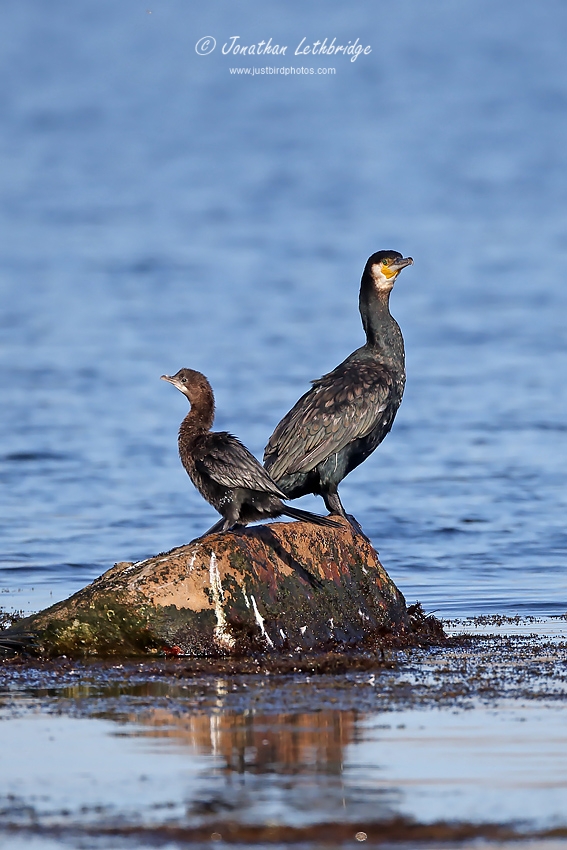
Pygmy and Great Cormorants


After breakfast we explored the coast immediately west of the village, Chengene Skele Bay. This delivered a good selection of waders that once again we could get nowhere near. Even the cowardly Cormorants buggered off, but not before I managed an educational shot from behind a rock which I now present. My Bulgarian list increased by Greenshank, Knot and Wigeon. In that order. 197, some serious excitement beckoned.


The best skywatching seat I have ever encountered

We gradually birded up through Burgas (there are lots of lakes and salt pans) to the migration hotspot of Atansovsko Lake. At the south side of this there is a spot where birders congregate to observe birds passing south, and without a scope we hoped to find some. As luck would have it there was one there, scope present and correct, and who should it be but Dancho, our guide from all the way back in 2012. I unfortunately did not reecognise him; like 98% of the population he now has a beard. The male population. But I of course have not changed a bit, and incapabale of growing a beard he recognised me straight away. Especially when I ID'd an Eagle as a Buzzard. With Dancho's help we got quite a good list here, but the birds came over at considerable altitude and photography was completely out of the question. Greater Flamingo became my 200th species in Bulgaria - again this felt rather suspiciously duff, but re-reading my blog from 2012 I cannot see any mention of Flamingos whatsoever so maybe this is in fact correct.

Dancho gave us some good gen about where we might get to within camera-range of birds, as well as news of a Bulgarian rarity at Poda, a Grey Phalarope. We had visited Poda on the 2012 trip, a key site for the BSPB, and I remembered it being good but hadn't been able to remember what it was called or where it was. In bright sunshine, the site for photography would only be good towards the end of the day, so we decided to head for Poda first, unfortunately all the way back through Burgas and some particularly annoying roadworks.

At Poda we racked up nearly 40 species, including loads of waders like Marsh Sandpiper, Avocet, Curlew Sandpiper, Spotted Redshank, and the mega Phalarope. This remained hugely distant, but here it is anyway. Proof we saw it.... sadly, as I will come to relate, this does not always happen. 


The final stop of the day was at the Pomorie Salt Museum. As Dancho had mentioned, we were finally able to get close to some birds. Mostly these were Dunlin rather than anything more interesting, but on day three of our trip and with basically one species satisfactorily lodged on our memory cards we would have taken anything. It was all too brief though, the light dipped and the birds moved further out. With some daylight remaining we checked out a few areas around the lake, and near the pumping station found a very friendly Water Rail which we earmarked for the following day when we hoped the light would be nothing short of divine. It had been a good birding day, the trip list had advanced hugely and my Bulgarian life list along with it. 


Tuesday, 6 December 2022

Another interlude

Sorry, sorry. I tried to write about seeing some Pygmy Cormorants, and well, you know. And anyway, is chronology really that important? No. I can cover the Black Sea coast later, and over on the "Trips" page it will be seamless. You will never know. Never know that a Blue-winged Mountain Tanager is one of the best birds I have ever seen. Even in the rain, of which there was a lot, this bird just shone. Seared my eyeballs with its magnificence. And it wasn't even the best bird out there. Not by a long shot. There is so much to tell, so much. The trip that almost never was, that Covid killed not once but twice, but that was clawed back. A third catastrophe and I think we were done, but we went, we saw, and we were stunned. And you will be too. After Bulgaria.