Monday, 2 January 2023

Round Two in the Park

As threatened I got up reasonbly early and headed for Wanstead Park. In winter it provides very different habitat to Wanstead Flats, and I was looking forward to a number of new species for the year having closed the opening day on 40 species. I heard Nuthatch and Stock Dove in the first few minutes, but straining for Firecrest and Treecreeper produced only Goldcrest, but at least my ears still work at this point. My arms are now almost not long enough to hold small print at a readable distance....

On Shoulder of Mutton I found a drake Teal and a Water Rail, and three Shoveler became 12 when a trio of out of control dogs charged in on the northern side. Amazing how the margins of small ponds can shelter so many wildfowl. Without help from dogs you wouldn't get anywhere near a decent WeBS count....


Heronry was a quiet affair barring two drake Pochard and a couple of Redwing, but it all kicked off on Perch with a Grey Heron, a Little Egret, a pair of Coal Tit and five Cormorant. The Dell held at least ten Siskin, reported at the very end of last year, and continuing into the Old Sewage Works added Chaffinch and more Redwing feeding in the paddock. I walked all the way to the Gates of Mordor in the hope of Cetti's Warbler and Kingfisher but found neither. It was however very pleasant and I even took my red hat off in the weak sunshine.

Exiting the Old Sewage Works towards the stables the Cetti's did the decent thing, the first time I think I have had it away from the water's edge. As it did so some gulls came past, loosely following the Roding but perhaps now cutting the corner. One of them was extemely large and slow-flapping, and pleasingly dwarfed a Herring Gull ahead of it. There had been a GBBG on the Flats both yesterday and today, both of which I had missed, so this was quite handy as it can be a hard bird here - mostly I see them flying across the Flats on some kind of commuter route. A Kestrel hovered above the paddock as I hit the stables. Plenty of finches at the usual spot on the corner, including my first Greenfinch of the year, but no Grey Wagtail on the dung heap.

My final stop of the morning was Bush Wood in the hope of Treecreeper, a bird that had eluded me all of last year but that Louis and Gosia had 'thermaled' earlier in the day. Pah! I can't complain, this is the way things are going, and thermal imaging is no different to noc-mig when you think about it. Anyway, next week I am getting my bionic eyes fitted. The left will have a 20-150x zoom, while the right will house the infrared. A retractable parabolic microphone will be installed in my left shoulder at the same time, connected directly to both the Merlin App and eBird, and visible via a HUD display in the brim of my hat. There will be no stopping me. Anyway, I couldn't refind the Treecreeper but I did bump into a Firecrest whilst searching for it. Once again I did not have my camera, but look, my trusty phone has done the job!


I am back to work tomorrow, so the fun is over for a few days. I find myself on 58, a semi-decent start. Last year it took me three weeks to get there, though the year before that I had 65 at this point. You can track my progress, should you be so inclined, on this page. Right, I am off for a drink. Oh wait, I am not drinking.....


Sunday, 1 January 2023

Starting again

I was expecting it rain, and therefore to be able to have a nice lie in. Unfortunately it was nice and clear and I was forced to get up. I delayed for as long as possible by having a small coffee and looking out of the window, but I had soon exhausted the slip pickings in the garden and was forced to go looking for more. Best bird out of the eleven species, Sparrowhawk. I didn't count the Golden Mallard, Anas fantabulosa, which hopped onto the balcony to stretch its wings - a spring migration to Ireland awaits and it needs to get into shape for the journey.


I tootled off towards Jubilee, not quite a spring in my step, but happy to in the fresh air. The days leading up to this point have all been spent indoors as the weather has been filthy. I just don't enjoy birding in high wind and rain, and Wanstead Flats does not have the same potential as Shetland to justify getting out in it. But today was nice, a bit breezy perhaps, but not too bad at all. Messages regarding bird sightings were coming in thick and fast, everything is exciting again after all. The best message regarded the continuing 2023 presence of a Dartford Warbler located in the brooms by James. The Stonechats that it came in with fled at the first sign of snow and ice, but these hardy little birds somehow stuck it out and are still with us. Note how I say bird plural. For a while now we have thought that there might be two, but nobody has really be able to prove it beyond doubt. Well this morning Tim, Sean, Bob and I did - with both birds in the same view at one point. Both active, and very vocal, and seemingly chasing each other around.

I ended my morning on 40 species, easing myself back into it slowly. The patch total was a pretty decent 62 I think, from multiple contributers. I'll go to the Park tomorrow rather than the Flats, it will have different ducks, Siskin, Nuthatch and the possibility of Grey Wagtail and Water Rail. 

By the way, the fireworks last night were spectacular. I generally hate fireworks, mainly because it takes almost nothing for people to set them off round here, but for the stroke of midnight on New Year's Eve I will make an exception. We watched from the balcony at Chateau L, and were treated to 180 degrees of sound and light, quite extraordinary. Many I suspect were simply from Londoners' gardens, but there must have been some official displays as well as some of these things were huge. The glut was obviously around midnight, but they continued for some time afterwards as there was no off switch....Anyway, so here we are in 2023. Happy New Year!

Colombia - Day 6 - Otun Quimbaya

La Florida


Oh look I'm getting up in the dark again. Love being on holiday! We were staying in La Florida, the last village before the paved road ran out, and that followed the Otun river south-east into the Otun Quimbaya reserve. Ernie got a morning off and we all squeezed into a single jeep that had come to take us up the track. We stopped when it was still dark for an attempt at a very special target - Hooded Antpitta. This is a reasonably well-known stake-out, but the window is extremely brief, the bird sings at dawn and not thereafter. Naturally Alejandro heard it first, but finding it was another matter entirely - this is one of the small ones that bounces around trees rather than runs along the ground, and it was very gloomy indeed at this hour. It seemed as if we strained into the forest with every ounce of our sense for ages, but in reality it was probably only a few minutes. Then all of a sudden it was directly in front of us, facing away, so dark that we could barely see it. It flicked left, movement giving it away, and then back again, and I caught a sensational view of the front half of it on a diagonal branch before it zipped away again and deeper into cover. Before coming to Colombia my experience of Antpittas was minimal, but I was beginning to see why they captivate birders so much. Magical. 

We carried on up the track until we could no further and paused for breakfast. We were introduced to a new fruit, Grenadilla, some kind of enormous passionfruit with the tasty bits enclosed in small translucent sacks that you kind of have to suck in in one go! Bloody delicious! A Colombian friend of mine said he could never eat them as a kid as they reminded him of bogeys! The road crosses the river here, before passing through some locked gates. Lots of bird activity at this time in the morning, including a Sickle-winged Guan, Common Chlorospingus, a pair of Andean Solitaire and also two Red-rumped Fruitcrow, but no luck with the hoped for White-capped Dipper and Torrent Duck. Some Bronze-winged Parrots flew over on their morning commute.


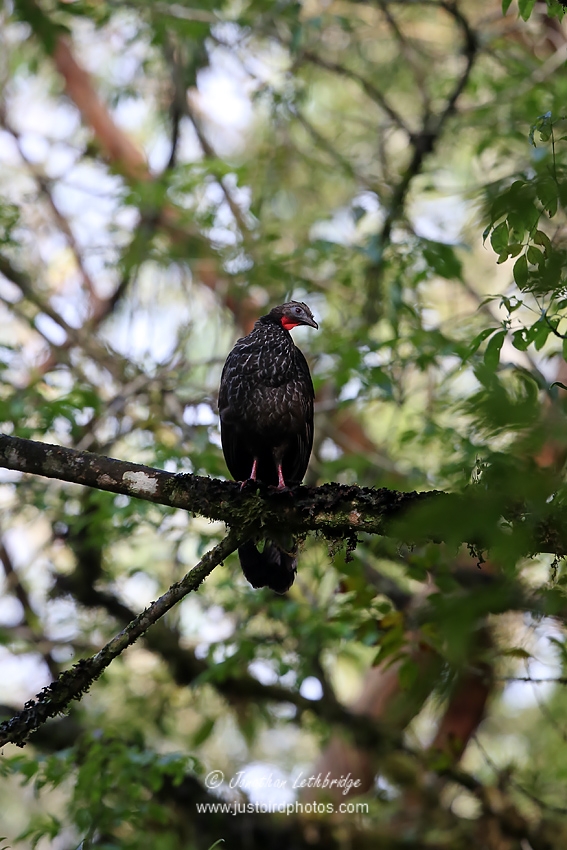
Sickle-winged Guan

Cauca Guan


The rest of the morning was spent slowly walking back down the track, with the jeep following a short way behind us in hops. We had not been birding long when a bird wave passed through that had Multicoloured Tanager within it, a much wanted species and one that is completely mind-blowing. I have no photo and you would not belive me if I tried to describe it! We saw masses here. Cauca Guan were fairly common, usually high up in the trees on seemingly rather insecure narrow branches, and we very nearly managed another Antpitta, Moustached, but the bird was only seen for a nano-second by Bob and Alejandro and the rest of us missed it. Red-crowed and Smoky-brown Woodpeckers got added to the list, and amazingly I actually saw a Tapaculo. Stile's Tapaculo is an endemic and we all needed it, and in a reserval of fortunes from the Ash-coloured Tapaculo experience at Rio Blanco I got a decent view of this tiny mouse-like bird peering around the edge of a thick dark tangle. Get in! Needless to say there are no photos, and in fact even though I carried my camera the whole morning I barely used it - too much birding going on and that was the clear priority. 

Spotted Barbtail

Andean Motmot

La Chiva!


Strong-billed Woodcreeper, Montane Foliage-gleaner, Spotted Barbtail, Variagted Bristle-Tyrant - apart from anything else aren't the names of these South-American birds simply fantastic? At a slightly open area that had been cleared for cattle were a pair of Southern Lapwings with chicks, and some small flocks of both Golden-plumed Parakeet and Scalet-fronted Parakeet flew over.

We returned to the hotel for lunch before leaving for Tatama National Park, initially back down the river to Pereira. A couple of quick stops in the forlorn hope of Torrent Duck did net Spotted Sandpiper and Torrent Tyrannulet, both new for the trip. Then it was a long drive through the city, heading west towards La Virginia and Apia. We made one stop along the road for Turquoise Dacnis, another endemic. Alejandro had a particular tree in mind, and remarkably this tree not only had the Dacnis, but also Green Honeycreepers, a Bar-crested Antshrike, four Blue-grey Tanagers, a couple of Bay-headed and Summer Tanagers, a Rose-breasted Grosbeak, an Acorn Woodpecker and a Black-billed Thrush. All in the one tree! I wish I could remember what it was, but it was clearly extremely attractive to birds! This is the value of a local guide; by ourselves we would have driven right past it....

Summer Tanager


We stopped at the mountain town of Pueblo Rico to transfer into jeeps for the final days of our trip - the famous Camino Montezuma. Ernie's van couldn't go up this track and he was headed back to Bogota. Duber and John were waiting for us in the main square, right on time, and after a quick coffee, an umbrella shopping spree, and some Cattle Tyrant photography we bade our farewells to Ernie and set off on the final leg. We arrived at the Montezuma lodge at dusk. Two and half full days of birding this highly anticipated area awaited us.


Cattle Tyrant


Saturday, 31 December 2022

Farewell 2022

Tomorrow is another year. Remarkable, where has it gone? Quickly is how it has gone. This is my final post of the year, a mighty 75th, and tomorrow the clock resets and we start again. I'll be staying local I think, possibly very local if the weather is as filthy as today has been. There is really no need to get cold and wet in order to tick Blue Tit again is there? Dry January beckons as well, this Christmas period has been ridiculous and there needs to be a pause. Hard I expect, but I will be fine. 


It has been a fun year - not a long of long-haul travel, but a fair few European trips including Spain, Portugal, France, Turkey and Bulgaria. Colombia easily takes any and all prizes for the best birding experience, but I also enjoyed visiting California again. Closer to home I saw two new birds in Wanstead, Merlin and Tree Sparrow, both massively unexpected. There was no way I was going to get anywhere near my 2021 total, but a tried to see what I could and ended on a respectable 115 which is my fourth highest total. I didn't manage to get to Shetland this year, but I did spend a lot of time in Fife and grew that list a little bit along the way. I'm hoping to get up there frequently in 2023 as well - the normalisation of working remotely makes this a lot easier. 

Anyway, thanks for reading, apologies the output has been a little patchy, and see you next year.


Wednesday, 28 December 2022

Colombia - Day 5 - Hacienda el Bosque and Los Nevados

Hacienda el Bosque


We left Rio Blanco in the dark, normal service resumed. Our destination was Hacienda el Bosque, a speciality site added to the itinerary specifically for....you guessed it, more Antpittas. The drive took about an hour and a half, and it was getting light as we arrived for breakfast. The hacienda is a dairy farm with a side-line in birding, and we were taken to quite a swish little restaurant high up the hill. You can stay here too, in rather nice looking huts. Breakfast was excellent, the best hot chocolate yet, and a Barn Swallow flew over. The main course lay below us, two Antpitta feeding stations - Equatorial Antpitta and Crescent-faced Antpitta.

We picked our way down to the former, hearing but not seeing Grey-breasted Mountain-Toucan, and getting some good views of White-browed Spinetail. The Antpitta stage was a little awkward, especially as a photographer had joined us and was stood exactly where I would have liked Juli (for that was its name) to pose. And then he used a flash and got told off, hey ho. This is what stupidly high ISO and a monopod are for - 6400 yet again in this case, oh for a more modern camera.


Equatorial Antpitta


We did not stay long as feeding time for the Crescent-faced Antpitta was approaching. We hurried back up the hill via a Barred Fruiteater, a Red-crested Cotinga , and some scope views of Grey-breasted Mountain-Toucan to the next set of hides. The feeding station was on a steep slope, with the bird calling from some way down it. Unlike the others which were largely slam dunks, this one was allegedly a lot trickier. Whether it was possible to dip or not I have no idea, but the encounter was tense and extremely brief, with the bird popping into view only momentarily before doing a runner. My one photo is extremely unsatisfactory, but such is life - the 8th one of the trip - hardly possible you would think but there it was.

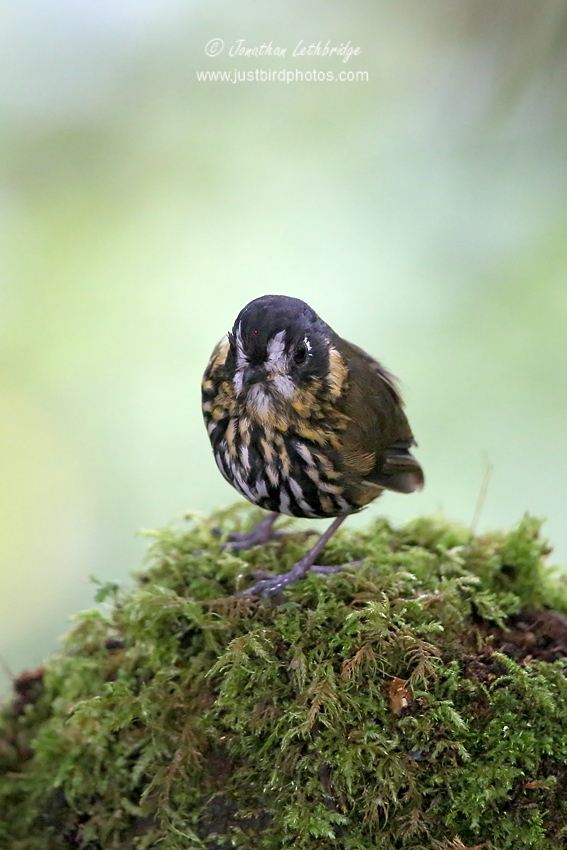
Crescent-faced Antpitta


The Hummingbird feeders right next to the Antpitta were far more enjoyable. I clawed back Sword-billed Hummingbird that the others had seen on the previous day, and new for the trip were Tyrian Metaltail, Purple-backed Thornbill, Shining Sunbeam and Buff-winged Starfrontlet. The names are just so evocative!


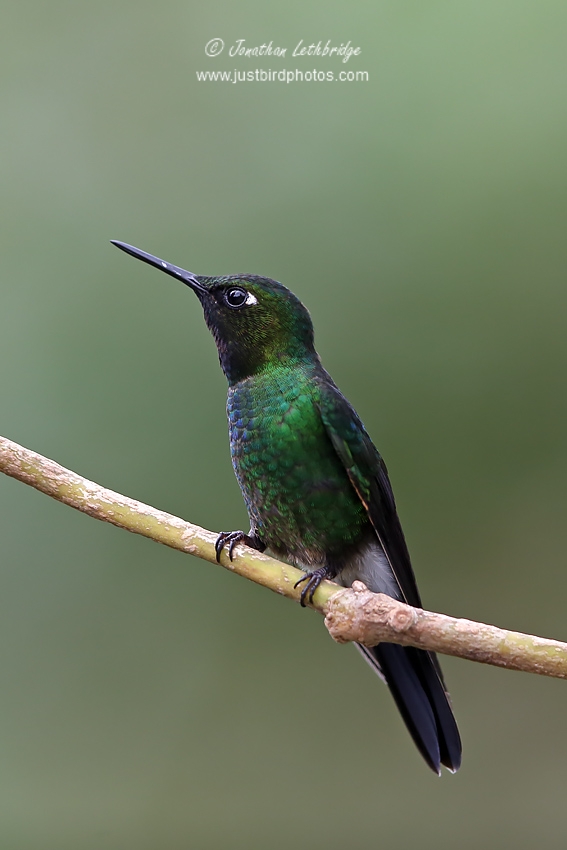
Tourmaline Sunangel

Shining Sunbeam. All the good stuff is on its back....


Time was pressing - any time spent at the Hacienda was time we would then not have at Los Nevados, and we had agreed with Alejandro that we had to leave by 9am once we had seen the key species here. Los Nevados was only an hour or so away, and as we increased altitude we began to see some new birds. At a mountain pasture covered with Great Thrushes we also got Stout-billed Cinclodes and Band-tailed Seedeater, and then we were into the clouds as we climbed to the Brisas Visitor Centre at 4138m. Things were noticely harder here, scurrying for a bew bird resulted in heavy breathing, and holding the camera steady took masses of effort. 


Stout-billed Cinclodes


We had the most amazing views of Buffy Helmetcrest imaginable, a male feeding on native Paramo flowers at what seemed like point blank range. In fact they were all over the place, with at least five zipping around through the mist. Good views of Viridian Metaltail as well, amazing that tiny Hummingbirds live up here. But it is not only Hummingbirds that live in this seemingly inhospitable environment, there is also an Antpitta up here. Not skulking in deep cover, not singing invisibly from a slope, but running around mountain paths - Tawny Antpitta. It seemed crazy that there would be such a bird up here, but this is the habitat, and sure enough we maintained our daily Antpitta hatrick with one seen briefly close the centre.


Buffy Helmetcrest - male

Buffy Helmetcrest - female


Viridian Metailtail

Tawny Antpitta

Plumbeous Sierra Finch


We made our way down to the Laguna Negra to look for birds that preferred a slightly lower altitude and less fog. On the lake itself we found several Andean Ducks (like a Ruddy Duck) and half a dozen Andean Teal. Andean Tit Spinetails fed in bushes by the roadside, and although it took a while we got some conclusive scope views of Many-striped Canastero. By now we had all begun to develop dull headaches due to the altitude but there is little you can do about this other than descend and wait for things to return to normal. 

Paramo habitat, with the tall Espeletia


We birded our way down the road, amazingly getting views of a Paramo Tapaculo that was unusually cooperative, and Brown-backed Chat-Tyrant. Lower still we came across a memorable spot where many birds were concentrated. Rainbow-bearded Thornbill and Golded-breasted Puffleg were new Hummingbirds, but Alejandro was far more excited by Masked Mountain Tanager feeding young, a very rare bird in the area and one that most people have not seen here. Get a photograph he implored! We also had Scarlet-breasted Mountain Tanager here, and Blue-backed Conebill. This concluded birding for the day, we had another longish drive ahead of us, back through Manizales to Pereira and then south-east to La Florida, ready to bird Otun Quimbaya Reserve the next morning.


Masked Mountain Tanager


Tuesday, 27 December 2022

Colombia - Day 4 - Rio Blanco

Manizales from Rio Blanco


Finally a day when we didn't have to travel anywhere! Although the distances we had to cover between Medellin and Pereira were not long in terms of miles, the mountain roads were in generally abysmal condition, with many landslides and other collapses, and a seemingly endless succession of contraflows and outright halts, sometimes for 20 minutes or more. Some of these roadworks were so establised that marketplaces had sprung up around them, with enterprising locals sellings tamales, arepas, other snacks and cold drinks as you waited. Some of our transfers ended up being well over three hours - we tried to do some of these before first light,  others during the middle of the day, but they nonetheless ate up a good portion of the trip. I am quite stupid in that I don't stop birding during the hottest part of the day, and push on regardless. In Costa Rica there were enforced halts after lunch at the lodges, but rather than take a siesta I would toddle off with my camera to some feeders. If I don't come back shattered from a trip I have not been doing it properly!

Anyway, this morning all we had to do was wake up at a sensible time and start birding immediately. In a neotropical paradise. Life is tough sometimes. After a quick breakfast it was time for the first Antpitta site, very close to the lodge. Miguel was our local guide for the day, and along with Alejandro and the gang we filed into the forest in what was a now familiar routine. I honestly cannot remember if the Bicoloured Antpitta had a name or not, but as with the others it was rather a star and came in more or less immediately.


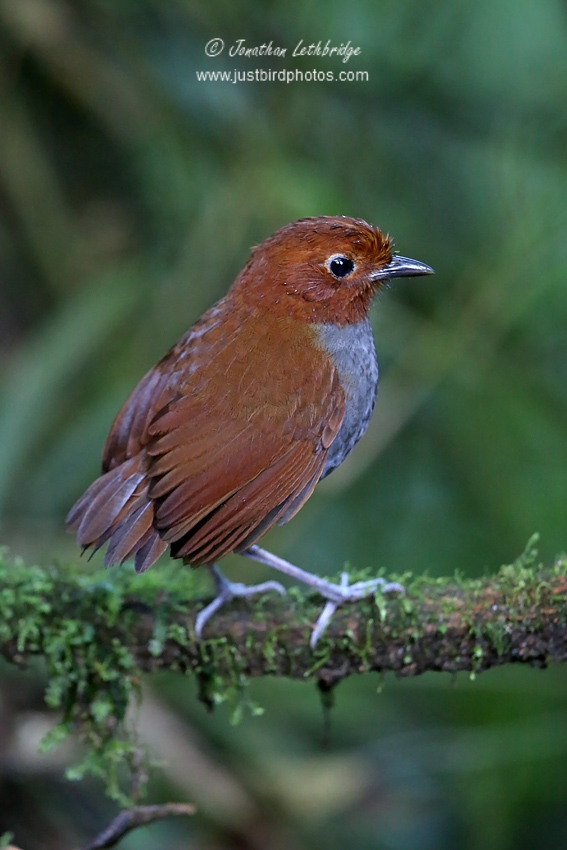
Bicoloured Antpitta

We did not spend a great deal of time here, the bird would come in and take the worm and disappear with it straight away. Perhaps feeding young nearby? We carried on up the track to the next delicacy. This time the Antpittas couldn't even wait, and had come out of the forest to ask what the hell was going on, why we were so slow, and that they were hungry and could we just get on with it. Always nice to get assaulted by a Chestnut-crowned Antpitta first thing. These were fantastic birds (Pancho and Pancha), and for photography it was the best yet, nicely open and with good light. In addition to insatiably scoffing down worms, Pancho found a massive beetle and smashed it to bits on a branch until all the innards leaked out - nice to see at least some natural behaviour. 


Chestnut-crowned Antpitta


The rest of the morning was spent slowly walking up the track deeper into the reserve, though in truth we barely penetrated it in the time we had. At the top where it splits we hit a bird wave - this is one of the most exciting things that happens when birding in the tropics, but also the most stressful when you have little idea what you are looking. It was a case of just try and get onto the birds one by one as Alejandro and Miguel called them out. I cannot recall the full list, but there were several Pearled Treerunner, Tyrannine Woodcreeper, Beryl-spangled Tanager, Capped Conebill, Streaked Tuftedcheek, Black-capped Tyrannulet, Cinammon Flycatcher and Barred Becard. It was non-stop, and although it felt like about half an hour I suspect it was a lot shorter than this.

Golden-plumed Parakeet

Tyrannine Woodcreeper


Once we had calmed down and recorded everything we had just seen, we turned right and past the finca. This is where Jazmin and her family lived. Through the gate and ane of the first birds we saw was Golden-plumed Parakeet, a small noisy group feeding close to the track - not something we had expected to get good views of. We also got decent views of Bar-bellied Woodpecker near here, and further on, also Crimson-mantled Woodpecker. It was all rather spectacular, and we only really scratched thr surface - other than the mixed flocks you can go for long periods seeing and hearing very little. Naturally we wasted ages trying to see Tapaculos. I think Dave managed a brief glimpse of Ash-coloured Tapaculo through a tiny window, the rest of us saw nothing. And the less said about Occelated Tapaculos the better, looking back it seems half the trip was spent hearing this bird call from a steep slope.

Brown-banded Antpitta


We came back to the lodge for late morning, this was the appointed time for humans to turn up with worms for a Brown-banded Antpitta. This bird was a new entrant to Team Antpitta, only on the roster for a few months and as such quite shy. Still, our sixth Antpitta of the trip which already felt incredible. 

Blue-winged Mountain Tanager

Rio Blanco Lodge


After lunch we took a short pause - our first siesta! Not me though - around the back of the lodge were some fruit feeders, and I pulled up a chair..... Luckily there was also a shelter, a corrugated roof, as it soon began to hammer down. A lot of my photos have significant streaks of rain in them! I saw 16 species from my seat during the hour and half I spent here, including superb views of Blue-capped Tanager and Blue-winged Mountain Tanager. Eventually the rain eased and we regrouped to go back up the track for another fruitless go at Occ Tap. The rain didn't stay away for long though, and it was not long before we were sheltering under some trees. I say sheltering, there is very little you can actually do in rain this intense, particularly without an umbrella - note to self; a small umbrella is a crucial bit of neotropical kit!


Slaty Brushfinch

Great Thrush

Blue-capped Tanager

Lesser Violetear

Speckled Hummingbird

Just like bird feeders the world over. Colombia is not immune from the scourge.


We made our way back to the Finca for some proper shelter to find the family playing "Rana" (Frog!) under the veranda. This is a game a bit like hoopla or shove ha'penny, but thowing coins or rings into slots which have different values. Dona Jazmin and Don Carlos were there with other members of the family, and of course Ernie was involved too! We were kindly given some coffee and were able to dry out a bit. Eventually the rain eased sufficiently to go back into the forest, but it was quite quiet, even the Occelated Tapaculo had given up! We tried for Nighthawks at a cleared area, hearing one distantly but only once. We came back in the dark, a long day, but a very satisfying one despite the rain check. Frustratingly a large Owl species flew across the track that we were not able to identify.

Rained off