Sunday, 16 October 2022

Turkey, September 2022 - Logistics and Itinerary


Turkey, 24th-28th September 2022

I travelled to Istanbul in April this year for a city break, but a boat trip up the Bosphorous during the spring migration convinced me to immediately book an autumn trip for the return passage. The flights are cheap, the country cheaper still, and there would be loads of possibilities for quality birding. As the date approached I started to wonder what to do - a quick check of eBird suggested a glut of lifers in the mountains south of Kayseri, with a number of others further south-east towards Syria. With another day I might have been tempted to try for these, but with limited time as well as various security concerns I decided not to push my luck. There would be plenty to see and it was already a lot of driving.

Mick and arrived at about midnight on a Friday night with a full five days ahead of us. The only concrete plans were a pre-booked jeep trip up into the Aladaglar Mountains to try for Caspian Snowcock, and a deep need to get in on the autumn passage action over the Bosphorus. We awoke bright and early on Saturday morning and headed east....

Logistics
  • A five day trip in late September departing London on Friday evening returning the following Wednesday evening.
  • Flights: from Heathrow to Istanbul on British Airways.
  • Covid logistics: nothing - all gone, and visas seem to be a thing of the past too.
  • Car Hire: Some kind of automatic Fiat. We only crashed it once.
  • Driving: The main toll motorway connecting Istanbul and Ankara and owards to Adana is superb, and in general even minor roads were decent. Turkish drivers are a little crazy and lanes are somewhat nebulous, so be on your guard. Also beware Spanish tourists....
  • Accommodation: The first night in Istanbul and then a hostel in the Aladaglar region were booked in advance, but all other hotels were booked on the day via booking.com. The only wrinkle was my credit card being declined from the first one and arriving at 1am to find my reservation had been cancelled whilst I was in the air.  
  • Food: Do you like kebabs?
  • Literature: The Collins and eBird. 4G everywhere, including in the mountains.


Itinerary

Day 0: Landed at IST at around midnight. Hotel shenanigans meant we didn't get  to sleep until gone 1am.
Day 1: Early morning headed east, first stop Izmit, the eastern end of the Sea of Marmara, followed by various stops towards Ankara primarily in mountain habitat looking for Kruper's Nuthatch. Overnight just north of Ankara.
Day 2: Morning at a wetland site, Mogan Golu, and then saltpan habitat looking for Larks and Sultansazlig. Overnight in Aladaglar NP.
Day 3: Morning jeep trip to the Arpalik Plateau around 2200m to search for mountain specialties. Afternoon excursion down to the Mediterranean coast near Mersin to boost the trip list.
Day 4: Morning in the mountains, and then an immense drive west to Istanbul. Overnight in Riva.
Day 5: Vizmig from the eastern side of the Bosphorus at a watchpoint called Toygartepe. Immense. A quick stop on the Black Sea coast before an evening flight back to London.


Monday, 10 October 2022

Autumn

Autumn for me has not really yet got going. I have been away - not Shetland or Scilly, I missed all that drama, although most of it seems to have played out online rather than onsite, which is nothing if not predictable. Lots of people saying other people should take a long look at themselves, but also suffering from a distinct lack of introspection. It is just too easy to bash out a tweet, a comment, a whatever, from afar without really thinking about how precisely the same thing happens daily much closer to home. I am not taking sides, if you want to bash twitchers and autumn rarity-seekers, you go right ahead. The photos from various sites look pretty crazy I'll grant you that - my tolerance for birding in a crowd gets smaller every day and the recent scenes have done nothing to change that. Equally if you want to go birding on Shetland and see skulking eastern birds you'll never see anywhere else, carry on, and ignore the haters - mostly they're just jealous I expect. I've been to Shetland many times, it is an amazing place and great fun - a sense of palpable excitement in the air each morning (which is sometimes over by 10am!), and the birders on there are united in their desire to look in bushes, walk ditches, peer over walls and slog through iris beds. If you are on Shetland and you don't want to be doing that, and are just hoping that one of these sibe megas is going to pop up right in front of you without any prompting then you are mostly going to be seeing nothing. It is not a cheap trip, and you are wasting your time and money. It does happen of course, but mostly you need to work to see birds as their natural inclination is to hide from you. And especially from big crowds of people all dressed in green.

I skipped it this year, not because of any of the above, but because I had no time. I've been birding abroad instead, and as my holidays are limited I have to make a choice. This year I've prioritised birding travel over domestic rarity hunting. You get to see many birds entirely by yourself that would draw enormous crowds on places like Scilly and Shetland, and increasingly I find this to be far superior to big lines of people along narrow lanes. I have been part of that of course - a Falcon, a Shrike and a Gull this year, and very exciting they all were too. I am glad I went, variety is the spice of life, I find a little of everything works very well. 

Toygartepe, Istanbul


So I suppose when I say autumn has not really got going I don't really mean that. I spent a morning on a hill above the Bosphorus and watched over a thousand Lesser-spotted Eagles sail east into Asia. If that isn't autumn then I don't know what is. I counted hundreds of Red-necked Phalaropes spinning on a shallow pool in California, and found bright Warblers feeding in tamarisks before heading south into Central America. Again I wager this is most likely autumn. I guess what I meant is that I have not done much local birding, or that is what it feels like. I have not yet had one of those remarkable vizmig sessions where you are acutely aware of passage. And I have not yet seen a true vagrant on these shores. And so now my focus will change. There is still plenty of time.

Saturday, 8 October 2022

On approach

When I fly I always book a window seat. I just love to try and pick out recognisable features on the land far below. There is something strangely satisfying about knowing that you made your way on foot along the features you can see from above, that it took you hours and hours but that in a plane you pass over it in an instant. The photos below are from a flight into London City Airport, down the Essex coast, up the Thames Estuary and then a loop around London Bridge and landing on the easterly runway (there is only one runway of course, but when there is an easterly wind you approach from the west, which requires a dramatic approach over the City and Canary Wharf). I think this was trip for work, travelling home from Glasgow. It was a magnificent day for flying, smooth as can be and with amazing visibility. I'm aware that not everyone likes flying, nor have much time for people like me who get on planes, but I make no apologies for it these days. Time in America recently has steeled me to our future - do what you want, it doesn't matter. You and I are but drops in the ocean compared to the excesses of the USA and other places, the way I see it there is absolutely zero chance that the excessive consumption there will ever change, even in the face of ever-increasing natural distasters like Hurrican Ian that just this weekend flattened a large swathe of Florida. They are not going to wake up. I'm well aware this is pure whataboutery, but we live our lives here so differently it is almost scandalous. We can all do better, but at the same time you need to enjoy it while you still can.

A coastal wind farm

Walton on the Naze

Greenwich and the Isle of Dogs

London Bridge

Canary Wharf


Tuesday, 4 October 2022

Range based identification

It is a funny thing, but you see what you expect to see, and you look over that which you do not. In my view birders whose brains are not wired like this are in a huge minority, and the masses, of which I am one, are generally all proponents of range-based identification. That is to say, if you are in a place where a species is resident or expected, and you see something that looks like it, it is very difficult to not record it as such. Combined with the human trait of familiarity breeding contempt many birds are unlikely to even get a second glance from the majority of birders. Those that do look more closely, carefully and above all, slowly, are in a different league from you and I. Well, I don't want to tar all my blog readers with the same brush, but I really really hope that this is not just me!

I was made painfully aware of this just recently in New York. The previous day a local birder had photographed a presumed juvenile Ringed Plover on the East Pond at Jamaica Bay. A very rare bird indeed, perhaps the third record for the State. The arrival of a UK birder, doubtless highly familiar with all ID features of juvvy Ringed Plover, distinctly cheered the many twitchers who had driven from all corners of New York. Oh dear. In the UK we are naturally taught to separate Ringed Plover from Little Ringed Plover, that is the confusion species, and if the two were side by side I could likely manage that. But to have a crowd of people all asking you, a perceived expert, if this bird here was the Ringed Plover, and not just another Semipalmated Plover.... Awkward!

I realised quite quickly this task was beyond me, mainly as I had no idea (other than the largely invisible feet) what differentiated non-calling juvenile Ringed Plovers from Semi-ps. Worse than that, I realised I could not really describe a juvenile Ringed Plover at all, or at least not in a way that was going to be of any use in this particular situation. I've been birding for years, but at that moment I appeared as if I knew nothing, a complete duffer. I muddled through it, and as far as I am aware nobody (with or without my 'help'!) saw the bird that day, but it was embarrassing and got me thinking. And writing this, as I expect that many people will be in the same boat and it would be nice to get them thinking too.


There are not many Ringed Plovers in Wanstead, although I live in hope. But even when I am at the coast, for example in Fife where Ringed Plovers are common, how much do I really look at them? The answer is not at all. If they are on a beach, as they normally are, I probably don't even think to look for LRP. I do a rough count, and they all go in the book as Ringed Plover. A day tick perhaps, and I move on. This is classic range-based 'identification', identification in the loosest possible sense of the word as in truth I have not ID'd the bird at all. I have just gone with the likely option, which 99.9999999% of the time will of course be correct, but does nothing whatsoever to enhance by birding skills. Or, as I just found out, my reputation.

Not all species are as tricky to sort out as Ringed Plover from Semipalmated Plovers of course, it is probably one of the worst possible conundrums to be faced with. I am struggling to think of another that is in this league - Snowy Egret vs Little Egret perhaps? Female Wigeons vs their American counterparts? Greenshank and Greater Yellowlegs.....The point is that you don't look at them closely, and the same can be said for any common species. Next time you are out take with you a piece of paper and three pencils - black, blue and yellow. Ask the first birder you come across to draw a Blue Tit. The results may surprise you. This is one of the reasons I bought an art pad and some pencils some time back. Have I used them? Have I f...

Anyway, a salutory lesson on how we mostly bird and how we ought to bird. I remember a day spent on the Aberdeenshire coast trying to find a Black Scoter amonst the flocks of Commons. It was one of the most exciting days birding I have ever had and it took me something like seven hours to finally and confidently pin it down. It was great, so why don't I do more of it?!

Monday, 3 October 2022

California & New York trip List

I spent three days in California and visited loads of sites, and about six hours in New York visiting just one, which explains why the former list is much longer that the latter. Here's the combined trip list. You can search for detailed site information on the Trip List that I created on eBird, found here.


Sunday, 2 October 2022

New York Stopover

The flight from LA landed at 6am, the onward flight to London departed at 6pm. Planning. I would not always do this, in fact a trip next year sees me return direct, but I wanted to see what the autumn shorebird passage looked like versus the west coast. I didn't have access to a car - or rather had chosesn not to - so my choice of destination was limited to Jamaica Bay Wildlife Refuge. No problem, it is a site I know fairly well, and I had been following with interest what had been being seen there over the last few weeks. My hope was that I would pick up the last of the passage, including Semipalmated Sandpiper, a species that I've seen several times in the UK  as a twitcher but inexplicably never in the USA as a birder. Hopefully I would be able to right that wrong!

I went to the Amerian Airlines lounge for breakfast and a repack - all the optics into one small bag, all the clothes and anything else into the rollaboard which I left there, hopefully nobody would mind. I made sure to display the bag tag, so that anyone worried by it would be able to connect it to the evening flight and assume I had gone for a walk somewhere. Which indeed I had. I hailed a cab and was soon out of JFK and heading down Crossbay Boulevard - it really is very close, although the route to get there is a bit circuitous. 
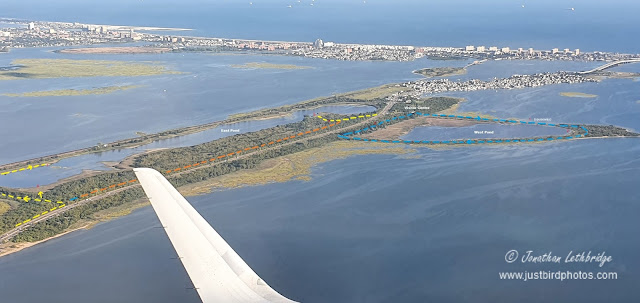
Annotated map of Jamaica Bay. Click to enlarge.

1) Causeway - viewing point for West Pond, 2) Terrapin Point (technically in Brooklyn...)

3) Woodland for Warblers etc, 4) Access Track for south end of East Pond

5) East Pond viewing point, 6 & 7) East Pond north end viewing points


As I was unpacking the optics and setting up my scope I met some birders who alerted me to a potential mega on the East Pond, a Ringed Plover. I hadn't quite envisaged running around after a European bird, and worse than that people might expect me, as a UK birder, to able to competently separate it from all the Semipalmated Plovers. Yeah right! I am afraid I am a proponent of range-based identifcation! Hats off to the birders who habitually and diligently scour through flocks of common waders or ducks looking for the one that is slightly different. Maybe if I was a coastal birder, but I'm not and in any event that's not me. I will return to this topic in another post perhaps.

I decided to swerve the East Pond for now and instead have a look at the West Pond which was much closer. At the causeway I set up my scope next to some excited birders who were looking at a Black-necked Grebe. A rare bird here but one I'd seen hundreds of in San Diego, it turns out that this was in fact a bird worth twitching here and Ari and his pal from the north of the State were doing just that. They too had heard about the Plover, and Ari kindly drove me and all my stuff over there (probably hoping I might be helpful!). It was good that he did because I had never visited the north end of the East Pond and getting to certain parts of it is a bit of a mission and unless you know exactly where you are going you could easily get stuck in deep mud.

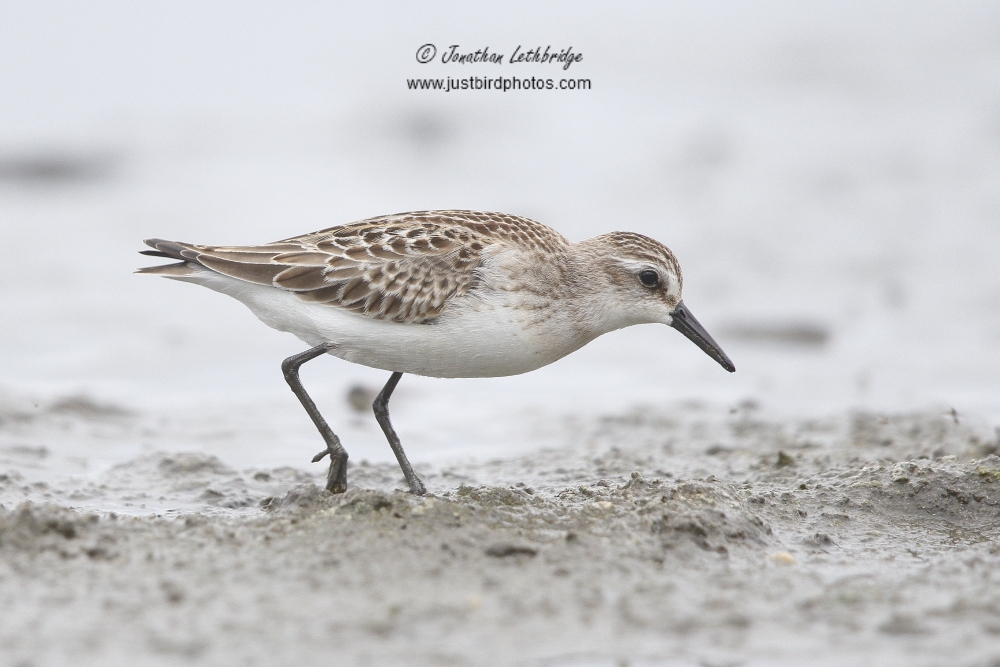
Semipalmated Plover

Semipalmated Sandpiper (Thanks Steve!)

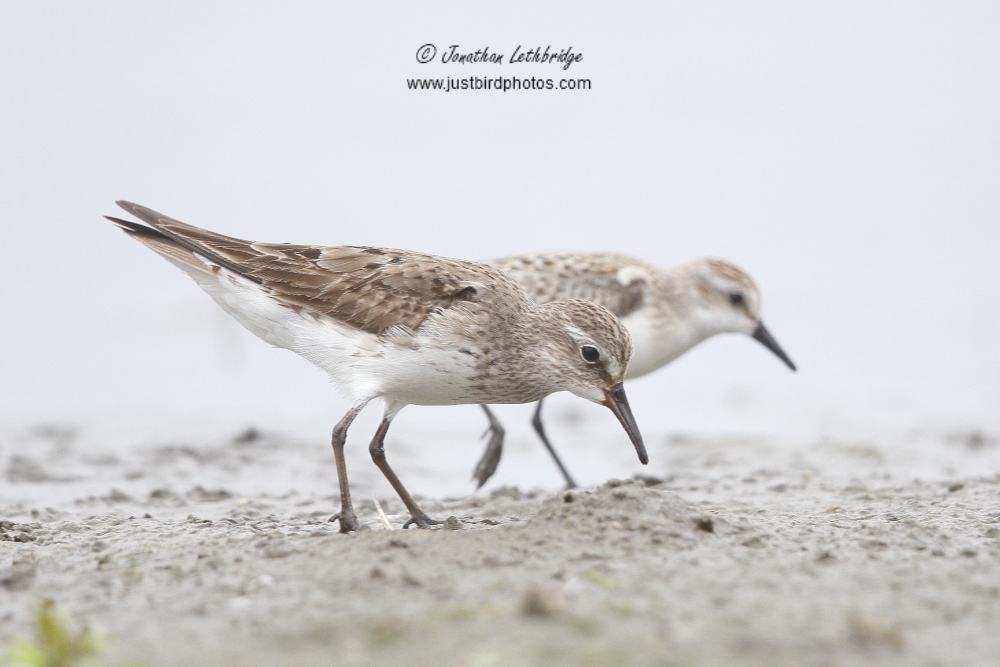
White-rumped Sandpiper with Semip behind. 


The water levels were fantastic, and there were waders everywhere. Semip fell easily, and there were tons of other species to compare it with - White-rumped, Western, Pec and so on. Of the Ringed Plover there was no sign - as the twitch grew a candidate was identified but just didn't seem right. The Pond is vast though, and most of it you cannot really get to. Everywhere we looked there were Semipalmated Plovers.... Birders kept arriving all the time, this would have been the third State record or something, but I am not sure that it was ever seen again. Whilst it was fun being around all the chat it wasn't quite what I had had in mind, but there was just time to scoop a true European mega, and one which I could just about recognise!

Behold an ABA Black-headed Gull!

I commenced the long walk back to the West Pond, which take you down a wooded ride alongside the west side but without any water visible. I added Carolina Wren, Northern Flicker and best of all, American Redstart which were quite numerous. It is a longish walk, perhaps tow miles, and I had not been back at the West Pond when some of the birders that had been at the East Pond arrived, somewhat incredulous that I had walked rather than get a lift. Maybe that would have been the smart option as I was now pretty knackered on what was a hot day. The airport, with its showers and air conditioning, was looking very attractive.
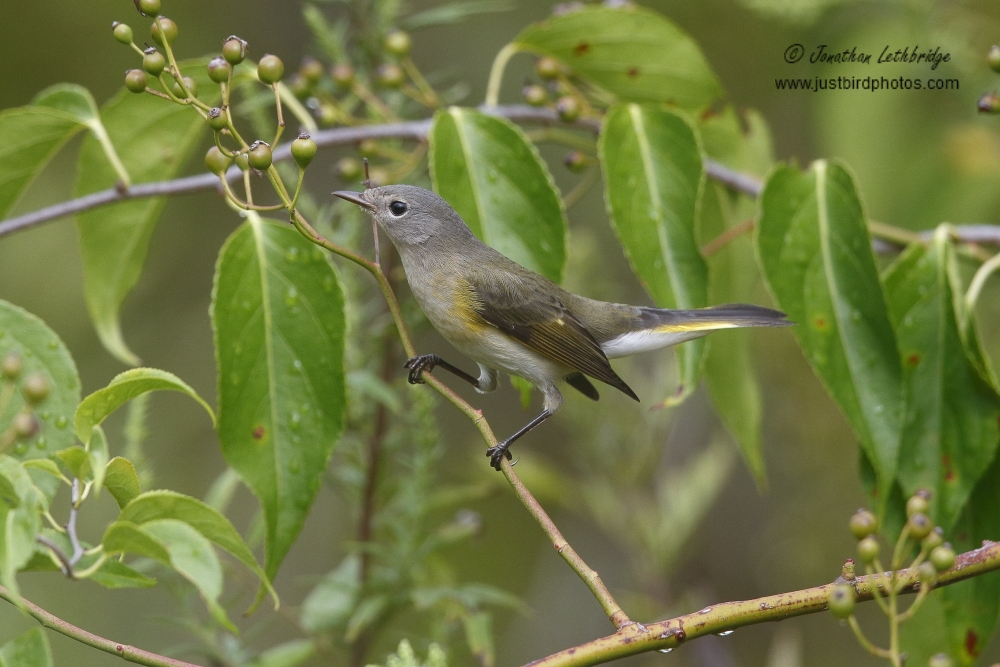
American Redstart


It had been a fun interlude, I had upped the trip list to over 150 and added a couple of new ABA birds - I am now knocking on 550. That will be the next target once the FX rates and car hire prices return to something sensible, but right now I am not contemplating booking any further trips to the USA beyond my existing April booking. The eBird Trip Report with lists and sites is here.

Saturday, 1 October 2022

Southern California - Day 3


Another early start, this time to try and chase down a Common Poorwill in a nearby canyon before sunrise. Somewhat amazing this actually worked, with the characteristic call being almost the first thing I heard at Tecolote Canyon at around 5.40am. A Great Horned Owl floated past as I was walking up too - a great start to the day. As the sun came up various bird started to sing from the hillsides, and eventually I managed to pin down California Thrasher and Northern Mockingbird. Despite a slight feeling of being hemmed in by the urban sprawl on either side - housing to the north, where the Poorwill was calling from, and the University of San Diego to the south, I had the place to myself for a decent while.

Eventually the first joggers and walkers of the day started to appear and I beat a retreat to a spot of breakfast down towards the Otay River - Huevos Revueltos con Chorizo, magnificent. I had unfinished business on the Bayshore - a vagrant Little Stint that I had managed to miss on a earlier visit, no doubt hiding in with the Least Sandpipers. Turned out that I had not been in the right spot and had been scoping a different lagoon. A short distance along the bike path I discovered a much closer sand bar with a good selection of waders on it , including American Avocet, Black-necked Stilt, Grey Plover, and lots of small peeps, including one that looked pretty good amongst the Westerns and Leasts. I also noted quite a few Wilson's Phalaropes , not sure how I missed them, and a very distant pool had hundred and hundreds of Black-necked Grebe in a tight flock. It is an incredibly rich environment at this time of year.

I am still not very good at phone-scoping....

Continuing in the spirit of cleaning up, I headed to Tijuana Beach to try and find the Flamingo and the Baird's Sandpiper. I got the latter, right at the end near the river mouth, but if there were any Flamingos they were doing a good job of hiding. I had a paddle in the Pacific and mucked about with Snuffi for a bit, reflecting on how fortunate I was. There are a lot of people around here that cannot say that - homelessness was rife in downtown San Diego. And as you head south there is one thing that you cannot avoid - the immense wall. From the beach where I was enjoying the surf I could see the border and the crazy security operation designed to keep Mexicans out of America. The fence, tracks, cameras, jeeps, quadbikes and presumably a lot more besides. A plane, probably with an array of detective equipment in it, droned constantly high overhead in a steady pattern. On the other side of the river the fence, Trump's 'beautiful wall', continued across the beach and well into the sea. You have to ask if it is worth it - the majority of the people I saw were hispanic anyway, and every single place I ate at was run by them. In fact the food was universally fantastic and I ate Mexican all the way.


By now it was past midday and with an evening flight from Los Angeles I had to make a bit of distance. But the birding was not over! I found a fabulous spot called the Oso Creek Trail in Orange County - again hemmed in by housing but full of birds. Here I finally found a Black-throated Grey Warbler, a magnicent male that I could scarcely believe was real having resigned myself to not seeing one on this trip. A nice selection of plastic was also present, with Pin-tailed Whydah and Scaly-breasted Munia. Along with all the Parrots I had seen I was starting to feel a little self-conscious, so to make myself feel better I used eBird to find both Egyptian Goose and Mandarin Duck on my way back to LAX. The lists seem to accept them all, I have no idea why and it is faintly ridiculous.


The Pacific part of my trip was done- California had delivered 136 species in yet another whirlwind tour, including 23 ABA lifers. When I set off my expectation was for perhaps a dozen, 16 if I was exceptionally lucky. I love birding in America, the last three days had been pretty wonderful, but I was not quite done with this trip...