Saturday, 26 July 2025

Brazil - The Atlantic Rainforest - June 2025 - Day 5 - Legado das Aguas - Cambuci Trail and ground feeders

The canteen at Legado das Aguas was more for the workers and researchers rather than visiting birders, and as such only opened at a rather sedate 7.30am. That said today would be on foot for the morning, birding the Cambuci Trail that started from the main compound, so we occupied the time from dawn birding around the buildings, the start of the trail, and the plant nursery. The day started well with a Collared Forest-Falcon calling from the valley. Its close cousin, a Barred Forest-Falcon, called from forest margins virtually outside the hut we were staying in and very brief views were had as it swooped away and out of sight. As it got lighter more birds began to awaken. Channel-billed Toucan were seen on the skyline, and Southern House Wren, Cliff Flycatcher, Long-tailed Tyrant and Grey-headed Tody-Flycatcher were around the buildings. At the start of the trail we found White-throated Woodcreeper, Plain-winged Woodcreeper, Buff-fronted Foliage-gleaner and White-eyed Foliage-gleaner. Grey-breasted Martin and Blue-and-white Swallow perched on the wires, and a Riverbank Warbler pootled about behind one of the huts.


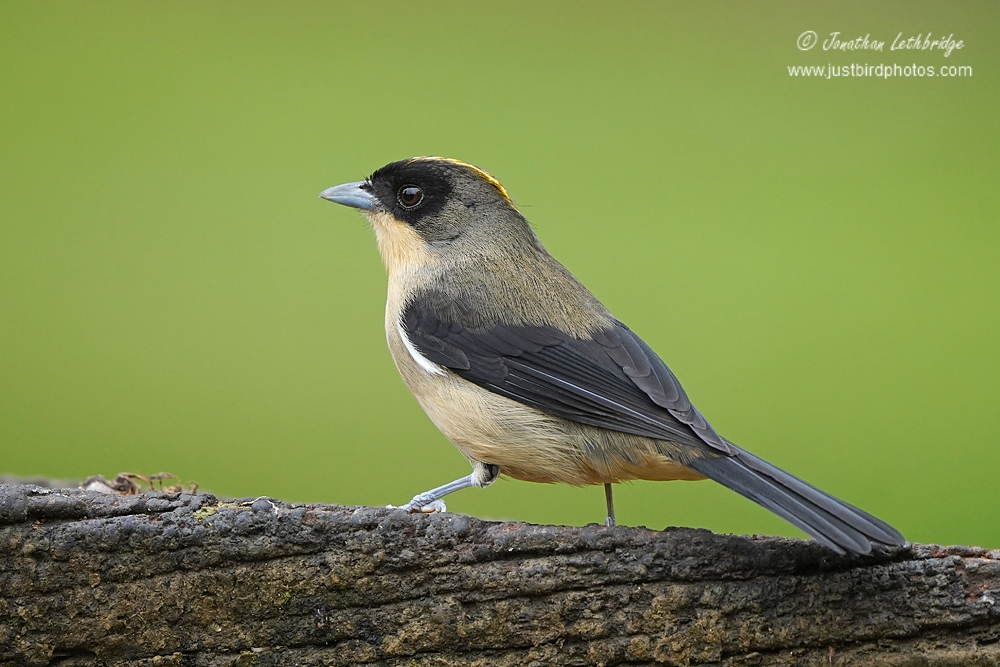
As breakfast beckoned we made our way back to the feeders on the terrace and Bruno went off to find some bananas. The birds were waiting! As usual it was a Tanager-fest, with small numbers of Olive-green Tanager, Black-goggled Tanager, Ruby-crowned Tanager and Azure-shouldered Tanager. The bulk of the hungry mob was made up of Green-headed Tanager and Red-necekd Tanager, probably 25 of the former and over 10 of the latter. Violaceous EuphoniaChestnut-bellied Euphonia and Plain Parakeet made up the rest of the small birds, but all these were put in the shade by the arrival of a gaggle of Saffron Toucanet, a bird Mick and I had been hoping to see. We had no idea how easy it would be - they literally fed just a few feet from us, incredible. A shame that this early in the day it was so dim. We had breakfast outside, and if you left your plate unguarded for even a moment it would be swarmed by Tanagers. Red-necked Tanagers are fond of scrambled egg, who knew?

Chestnut-bellied Euphonia


Plain Parakeet

Saffron Toucanet

Red-necked Tanager

Ruby-crowned Tanager


Suitably geed up we gathered our gear and headed for the Cambuci Trail, and loop that goes up a gully to a waterfall and back again, part path, part raised walkway, no more than a mile there and back, but intensely birdy. We were into new species almost immediately, with Salvadori's Antwren, a male Scaled Antbird, Streak-capped Antwren, several Saw-billed Hermit and various Woodcreepers on the way up. On the way down the other side we encountered Sharp-tailed Streamcreeper, Whiskered Flycatcher, Short-crested Flycatcher, a Yellow-legged Thrush, and best of all, stonking views of a Russet-winged Spadebill - this is the bird we had missed in the rain at Intervales. Despite the short trail we managed to spend the entire morning here, timing our exit to perfection as a noisy group of excited teenagers on a school trip entered the trail just as we were coming out. They didn't spend long in the forest, joining us for lunch a short while later. When I say joined, what I mean is that they descended on the buffet in a ravenous mob, leaving it virtually bare as they staggered out to the terrace with plates piled high. I have teenagers of my own and know how much they can eat... we waited for the chef to replenish the table and timed our visit before they then came back for masive seconds. We only just made it. A mega bonus pair of Black-and-white Hawk-Eagle flew over the compound just as we were leaving.

Saw-billed Hermit

Russet-winged Spadebill

Sharp-tailed Streamcreeper

Mick and Bruno on the Cambuci Trail


Our destination for the afternoon was a ground-feeder hide just outside the reserve. I am not the biggest fan of hides, but it seemed that this was the only way to see certain birds so I just had to grin and bear it. In fairness it worked out brilliantly, but it did mean two and a half hours sat on a bench with a few mozzies for company. During the time we spent there we were graced by a White-tipped DoveGrey-fronted DoveRuddy Quail-Dove, Rufous-capped Antthrush, six Spot-winged Wood-Quail and a Brown Tinamou, all incredibly shy birds that you are highly unlikely to ever see as you are walking along a trail. Photography was virtually impossible, and exposed the ISO limitations of (in these circumstances) my decidely budget camera body and very slow lens. This was one of the occasions I dearly wished for my Canon 500mm and 1D body back - I would have done a much better job even without a flash. 

Spot-winged Wood-Quail

Grey-fronted Dove


So that was day 5, a full day at Legada das Aguas. We finished the evening with some  more abortive Owling - Owls heard, but not seen. The Caipirinha showed well though.

Tuesday, 22 July 2025

Brazil - The Atlantic Rainforest - June 2025 - Day 4 - Intervales State Park and transfer to Legado das Aguas

We started the day with another attempt at Variegated Antpitta on the trail near the restaurant, the Trilha da Barra Grande. Betin knew of a bird there that he hoped to coax out. The bird was present, correct, and uncoaxable. I've forgotten the exact score but we were several down already and it wasn't even half time. Leaving the Antpitta to play hide and seek with itself we continued a bit further and were rewarded with a pair of Hooded Berryeater, very hard to see in the canopy but eventually one stayed still long enough to get a good view. This was one of the key birds we 'needed' to see here. There were also two Rufous-capped Motmot on the trail in the half-light.

We popped in to the ground feeders to see if any Wood-Quail were around, but it was quite quiet other than a....Variegated Antpitta calling from the track a short way below the feeders. We gave this bird half an hour standing silently in the forest as it called from our left, then our right, then our left again, without ever giving itself up. This is the way. Good views however of another Green-backed Trogon and a Red-Ruffed Fruitcrow.

Bruno taking the same photo I did - it became the trip report header

Betin looking out at Helmeted Woodpecker landscape


The rest of the morning was spent on the Carmo Road. This time we drove further down, even managing to get the car underneath the fallen tree, which meant we got further away from humanity. The habitat appears the same, but I suppose that the deeper into the forest you get the more cohesive it becomes. This was certainly the case as we had not been gone from the vehicle long when Betinho called a Helmeted Woodpecker. Bruno was a short way behind us and came running - when a veteran bird guide starts running you know you are onto a good thing. It showed fantastically well for a bird we had virtually no chance of seeing. Bruno had not seen one for an eternity, and even Betin had had a blank year in 2024. This is a bird that even the people who spend days and days here hardly ever see. It came in from down the slope and then crossed the track to call from some tall trees above us. Two Black-fronted Piping-Guan were in the same tree.....I love it when a plan comes together. We also had excellent view of many Ant things - Spot-backed Antshrike, Tufted Antshrike, Plain Antvireo, Ferruginous Antbird, Ochre-rumped Antbird, Streak-capped Antwren and Squamate Antbird. A feeding flock of Tanagers contained another new one, Brassy-breasted Tanager, and we were also treated to two pairs of Magpie Tanager and several Cinnamon-vented Piha were in the same area. A very vocal Least Pygmy Owl played the Antpitta role.

Helmeted Woodpecker

Black-fronted Piping-Guan


Late morning we returned to the Pousada to pick up our stuff and gave the ground feeders one more go. Guess what? Bruno could tell we were itching to get back to the feeders at the village so we did not linger. Who needs Wood-Quail anyway?

Dusky-legged Guan


At the village Mick outdid himself with a spectacular new perch complete with air plants, we almost decided to skip lunch. As ever it was a Tanager-fest, although perhaps not with the breadth of species that had been there the day before. The overall list, by this stage at 180+, was augmented by a Ringed Kingfisher, a Ruddy Ground Dove and a Cliff Flycatcher, and I also finally managed to see Red-rumped Cacique, a bird that everyone else had seen daily but I'd always been looking in the opposite direction. I love feeders.


Rufous-bellied Thrush

Brazilian Tanager, female

Brazilian Tanager, male

Blue Dacnis, male

Red-rumped Cacique

Green-headed Tanager

Olive-green Tanager

Social Flycatcher


Azure-shouldered Tanager


It was time to leave. Intervales had been fantastic, surpassing my expectations. We had birded every day from first light to the early evening and sometimes beyond. We gave the fantastic Betinho a small parting gift and headed out the way we had come - there is only one road. There was one more bird to try for though, and a few miles later we stopped at a known locality for Grey-throated Warbling Finch. One duly obliged - this is at the northern limit of their range. And then it was time to drive. Legado das Aguas lay to the east about four hours away. It does not seem that far, but the dirt entrance track is a full 30km long and takes well over an hour. I amused myself by eBirding from the car, trying to populate as much of the Sao Paulo grid as our route would allow.

Slaty-breasted Wood-Rail


We arrived at the reserve headquarters just before 5pm with just enough time to enjoy last knockings at the feeders on the balcony. The reserve has an interesting history, one that I found quite surprising. Back in the 1940s or 50s a Brazilian industrial conglomerate called Votorantim purchased a vast area of the Atlantic Rainforest in order to build a series of small hydroelectric dams to supply its factories. This does not sound especially like a conservation story at this point, however although the dams flooded a portion of the forest, the remainder was preserved as a natural reserve and is now one of largest areas of privately protected land in the State, with a role in education (we encountered a raucous school visit!), a huge nursery dedicated to propogating rainforest species, and research. The result is this huge area around a series of lakes and dams that is essentially untouched. Right in the middle there is a research station with a number of - it has to be said - quite spartan cabins, a canteen, and the nursery. And that's it - the Legacy of the Waters. We finished off the day with some well-deserved Caipirinhas as the sun went down over the Mata Atlantica.

Legado das Aguas


Monday, 21 July 2025

Brazil - The Atlantic Rainforest - June 2025 - Day 3 - Intervales State Park - Lajeado Trail

Trilha do Lajeado


Another early breakfast, another early start. Today we were going to bird the Lajeado trail, one of the best spots in the park for the hard to find Russet-winged Spadebill. It's a long trail, mostly downhill along the contours of a hillside, crossing a stream and then continuing further into the forest. About 3km in is the house that Betin was born in, now a ruin. It was dense and shady, and actually rather quiet. Perhaps the birds knew that rain was on the way? As we reached the end of the trail, or at least about as far as the house was, it began to rain. It was only 9am, the weather app had promised that it wouldn't rain until the afternoon. Weather apps in rainforests are useless, I probably should have known that. So at the far end of the trail and as far from the car as we could be, we faced an 3.5km uphill slog on a slippery track in the rain with no birds. Excellent. The perils of birding. However after my experiences in Colombia I now always bird in the tropics with a small umbrella, and this came to my rescue. Mick had left his umbrella in the room...


That said, the walk down - lack of Spadebills aside - had actually been pretty good, and over a couple of hours we had seen upwards of 40 species. These included Surucua Trogon, Lineated Woodpecker, White-browed Woodpecker, Streak-capped Antwren, White-shouldered Fire-eye, four species of Woodcreeper, five different Foliage-gleaners, a splendid Red-ruffed Fruitcrow, Wing-barred Piprites, Grey-hooded Flycatcher, Sao Paolo Bristle-Tyrant, Red-crowned Ant-Tanager and Brown Tanager. No photos, too dark and too wet.

We reached the car just as it stopped raining. Or perhaps it continued to rain along that particular ridge and we were simply now clear of it? Whatever, it was a shame that it had rather curtailed the morning's birding, and had meant the Spadebill had not shown (another visiting birder went down the same track in clear weather the following day and had great views!). We were assured by Bruno that we had another chance at Legado das Aguas.

The park entrance

Rufous-collared Sparrow

White-throated Woodcreeper


With time to kill before lunch we spent the rest of the morning around the buildings near the visitor centre. Around the corner from where we had seen the Red-and-White Crakes earlier in the trip was another small gap in the reeds. This was the feeding station for Rufous-sided Crake, and it wasn't long before one appeared for a meal. It was very shy indeed, and at one stage was chased away by a Red-and-White Crake! Close by we found a Southern Yellowthroat and a Violaceous Euphonia, a White-throated Woodcreeper and the usual cast of Saffron Finch, HorneroRufous-collared Sparrow, Masked Water-Tyrant and Rufous-bellied Thrush.

At the village we scoffed down some food to maximise time at the feeders. Earlier in the morning after breakfast we had reconfigured the perches with a new mossy branch we had found and it was apparent that the birds didn't seem to mind it. Their focus was exclusively bananas, mossy branches were irrelevant. Indeed the biggest problem was that they barely spent any time on the branch at all as they were so fixated on gorging themselves on fruit. In short it was wonderful, with Olive-Green Tanager, Black-goggled Tanager, Ruby-crowned Tanager, Brazilian Tanager, Sayaca Tanager, Azure-shouldered Tanager, Golden-chevroned Tanager, Palm Tanager, Burnished-buff Tanager and Green-headed Tanager all visiting. Brown Tanager came into the tree but never down to the fruit. Variable Oriole were in the Araucaria, and we finally had good views of Campo Flicker.

Olive-green Tanager

Azure-shouldered Tanager

Golden-chevroned Tanager

Black-goggled Tanager

Green-headed Tanager

Brazilian Tanager


Ruby-crowned Tanager


We stopped on the road between the village and the park briefly as it was a good spot for Grey-bellied Spinetail. These were duly persuaded to pop out of the bushes, and we also saw our one and only Fawn-breasted Tanager here, a pair of Grey-headed Elaenia, and a Mottle-cheeked Tyrant.

Back in the park we birded around the Casa de Pesquisa. Unicoloured Antwren showed nicely, as did Lesser Woodcreeper, and a Laughing Falcon was perched in a dead tree. A Brown-breasted Pygmy-Tyrant showed very nicely after a short while, as did White-browed Foliage-gleaner, and several Long-tailed Tyrants perched on the wires near the house but never anywhere for a nice photo. 

Southern Lapwing


Back at the site where we had seen the King Vulture the previous evening we burned another half hour or so on a recalcitrant Mouse-coloured Tapaculo. There were actually two here, very very close to the road but we could see neither. A tough gig. Good views were had of Planalto Woodcreeper and Streaked Xenops though. So a bit of a mixed day, with rain and Tapaculos taking the honours, but the session at the feeders had been just what we had wanted. We still had the following day to eke out a few more species.

Saturday, 19 July 2025

Back to brown

A short interlude from lovely bright things to rubbish browny black things. No, not Tapaculos. Wanstead. I've always struggled to get back into local birding after a trip away, it just seems so unsatisfying. This is magnified when returning from the neotropics. So much so that I simply hid my binoculars when I got home from Brazil and it was only as recently as the end of last week that I finally dug them out again and faced the inevitable.

The patch.

My last proper visit was in mid-May when it was green. It is now brown and parched, and as some of you may have spotted in the news, burned and blackened. A familiar story each summer. This time it was over near Alex where the crack dens are, no surprises what happened. Bob and I strolled over there on Thursday morning to take a look. Of course this area has been burned to a crisp several times before, and in fact the Corporation has vastly reduced the amount of cover there in an effort to, er, smoke them out. Still, there remained enough to create a fire of sufficient size to require ten fire engines and 70 firefighters....


The patch news does not end there though. On the banks of Alex, wader-free as always, Bob and I put up a Grey Wagtail. This was actually a year tick and so very exciting. I've been somewhat half-hearted in my pursuit of patch ticks this year, and after a few abortive trips to the stables and the Old Sewage Works earlier in the year I had given up knowing full well that several Grey Wagtail would fly over my head on the Flats in the autumn. So it's a fraction early but I'll take it.

Then on Friday I went for a short bike ride on the patch, through the Park and then across to the Flats. I was minding my own business next to Alex, thinking vaguely about counting the Geese even though I'd pointlessly counted them all on Thursday. Listlessly I scanned the Gulls. Oh, an adult Yellow-legged Gull. Par for the course in late summer and, just like that, another year tick. 

I'm off for a lie down.

YLG. Phone shot. Mmmm mmmm.