Tuesday, 14 March 2017

A short stay in central Vietnam

Rather than stay in Hong Kong, a city that as a family we have already "done", we went to Vietnam for something different. I say "done", I'm not sure you can ever really do Hong Kong any kind of justice in any kind of reasonable timeframe, but with holiday time very limited it's important to get as much variety as you can. My sister suggested Vietnam as a sufficiently different and interesting destination only a short distance away, although in truth almost all of Asia is just a brief hop away. Within the same range as Europe is from London are a host of incredible places. So Vietnam it was, the central coast a mere 90 minutes flying time away. Cathay Dragon accepts the same airmiles as BA, and no taxes to speak of meant a family of five could travel for about £60 return which is amazing.

So it was that less than 24 hours after arriving at Chek Lap Kok we were back there and heading back west. Da Nang is an up-and-coming (read: getting rapily buried in concrete) city that held no appeal, but only a moderate taxi drive away is Hoi An, a world heritage city that retains a huge amount of original buildings and a great deal of charm. Apparently Vietnam is a Communist state but you could have fooled me. I saw almost no evidence of restraint, and a massive amount of rampant capitalism. Perhaps better to say that a one party system is in operation. Still, when one pound equates to something like 30,000 Dong I can bear a bit of capitalism. The first ATM we encountered offered three choices - 100,000 VND, 500,000 VND, or 1,500,000 VND. I had unfortunately neglected to gen up on the above exchange rate, so cautiously went for the middle one, whereupon the machine spat out a single note. Hmmm. Hailing a taxi, I tentatively asked whether half a million Dong would be sufficient for the ride to Hoi An and was told it would be fine, but it was a very close run thing and I ended up giving the driver the whole lot for the 45 minute trip. Happily the hotel accepted credit cards so we were able to have dinner....


After a slow start the next morning another taxi took us into the town, dodging half a billion crazy mopeds. We stopped for a more sensible amount of cash, making me a local millionaire in the process, and set about exploring. I won't bore you with a minute by minute rundown of our holiday, but suffice to say it was fabulous - we had some work clothes made at a couple of tailors for which the town is famous, we visited the market, we went to a cookery school, walked through paddyfields, visited an ancient temple complex, chilled by the pool, shopped for silk lanterns (more on this in another post, for me it was one of the standout things about the town) and very small but highly satisfying hats, drank cocktails, played ping pong, had massages, saw monkeys.... in other words a highly varied family holiday. 


There was some properly tropical rain!


And of course I snuck a bit of birding in. Genuinely a tiny bit, hardly any. An early morning exploring the paddyfields and fishponds, and a bit of sneaky birding whilst being shown around some temples. In my experience there are only so many templey-type things that you can take in, whereas there appears to be no limit to how many birds I can hear, see, or generally be interested in. My visit to the ancient site of My Son was therefore dominated not by Gods and phallic symbols, but by Greater Racket-tailed Drongo, Common Iora, Scarlet-backed Flowerpecker, Coppersmith Barbet and various Bulbuls. Oh, and Yellow-browed Warblers, well out of place and not an iris bed in sight.

The paddies closer to the town were stuffed full of Egrets - GWE, Cattle Egret and Chinese Pond Herons mostly, but also a few cool things like Yellow Bittern and Cinnamon Bittern. Plenty of Richard's Pipits and for that taste of Europe, Zitting Cisticolas. Distinctly un-european included Plaintive Cuckoo, White-throated Kingfisher, Green Bee-eater, Black-shouldered Starling, White-breasted Waterhen and masses of Swiftlets overhead of a species I could never identify 
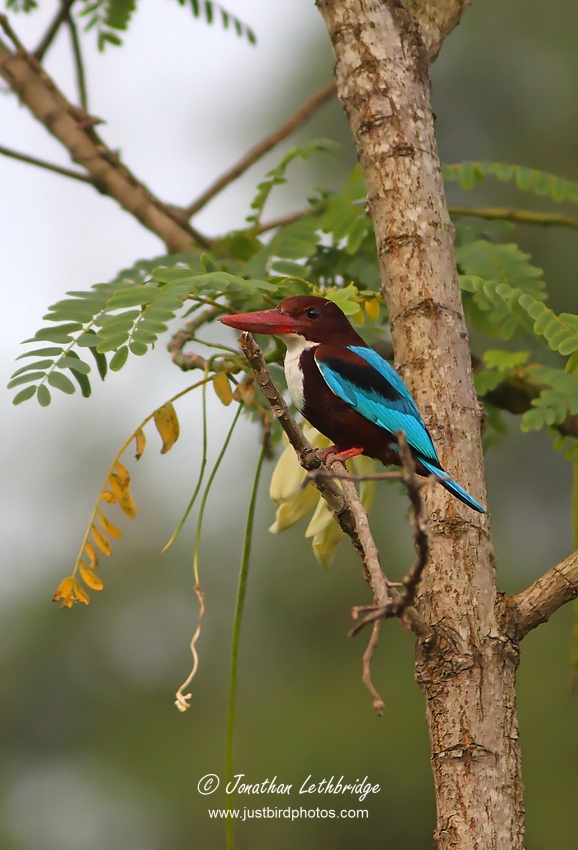


I had read before travelling that central Vietnam was birdless, so I was really very pleased to see as much as I did, something like 20 lifers and a list of around 50. I think what the various reports I read actually meant to say was that whilst central Vietnam had quite a few birds, the real hotspots are in the north and the south, so on any trip to the country make sure you go there as a first choice. One day I will, and no doubt I will be amazed, but as a bit of casual birding on a chilled-out half term holiday I came away more than satisfied. 


Saturday, 11 March 2017

The dating game

Here are some dates.

March 16th
March 23rd

March 20th
March 19th
April 10th
March 11th

The final date is today, and is very nearly an entire month earlier than the date the precedes it. These are not random dates, they are significant dates. Very significant - they mark - of course - the dates when I saw my first patch Wheatear over the last few years. I am not quite sure what happened last year, but statistics never ever lie. Leaving this aberration aside, the 11th March is nearly a whole week earlier than the earliest I've seen Wheatear in Wanstead. So naturally for someone as nerdy as my good self this is extremely exciting news.

I was with Tony - the last few Saturdays it has just been the two of us (he would be lying if he said he didn't look forward to this tryst), the rest of the gang seem to have slacked off somewhat. We had done an unproductive circuit from around half six and seen very little. A second go was merited, so crossing the road back to the brooms we trundled on. A few Skylarks, various Mipits and Song Thrushes. And then it happened. A bird with a very different flight bounced over, moving away rapidly. The ever-sharp TB called it tentatively as a Wheatear, and as it headed into the top of the Coronation Copse it appeared he was right. I thought I detected a white rear end despite the high contrast, and when we noticed a man who later resolved into Rob S waving at us and pointing at the same treetop we knew we were in.

A smart but highly wary male, and on the exceedingly early date of 11th March. This is karma. I spent a lot of yesterday gazing at photographs of Wheatears. Wondering. Hoping. Salivating. And today was the day. Thankfully I got up and got out there, this was the moment I wanted to be present for.  So here it is in all its glory. Friendly it was not, but you can't have everything. Spring has well and truly started. Tony, Twitcher-Bob and I discussed a possible retreat until late August until the Spotted Flycatchers turn up, but I suspect we'll be out again very soon hoping for more. This is just the beginning.


Tuesday, 7 March 2017

Spring is in the air!

I can feel it, it is mild, and I can be birding by about six in the morning. Sometime, if I am very lucky, I can leave work while it is still vaguely light. I did so tonight and with a spring in my step, and my first (and so far only, though that may change) gin and tonic was on the way down at about half six. It does not feel like it has been a long winter, and barring that short spell of frost in January is has remained fairly mild for the whole period. My plants are thankful.

I didn;t get up at six obviously. I lounged around in bed for far too long and didn't make it out until gone seven. There were no birds, and a thousand dogs. Nonetheless it felt good to be out, and there was always the threat of promise. Now is the time. I read today that there has been a Wheatear in Lothian. Lothian! Talk about a world-beater. Ours tend not to arrive until a little later, and my earliest local record is March 15th though around the 20th to the end of the month is more regular. This suggests I have about a week until the first hint, and probably a fortnight before it becomes nailed on. You read it hear first. To say I am looking forward to it is the master of all understatements. As a reminder, here is what they look like.


This is my favourite time of the year on many fronts, not just the birds. I can start de-wintering the greenhouse, moving things that have spent the winter clogging up the house. I can while away hours repotting, rearranging, cleaning and dusting leaves. In turn I can bring things out of the greenhouse and onto the terrace, transforming the landscape into the arid tropics. But best of all is the end of the darkness, I can get outside and actually see things. The sun might deign to warm my face, and I don't have to wrap up as much. It's a kind of newfound freedom that is eagerly anticipated every year, with the bonus of masked bandits bounding down green paths.  

Monday, 6 March 2017

Am I on Shetland?

There is a funny buzzing sound. There it is again. Ziiip. Wait, is that a Pipit? Quite stripey. Ziiip. Oh, there are two. Ziiip, ziiip. Actually, there are several. Lots in fact. All over the place, two more on that putting green, another there with that Wagtail. Ziiip. Oh, one over there in that tree. Gosh, they're not hiding very well are they? Can't be a rare Pipit if I can see it can it? Ziiip. Let's have a closer look. Hmmm, yes, quite creamy on the front, lots of stripes. And quite greeny on the back. Olivey some might say..... Ziiiiiiiip! 

Ooooh, and what's that "boing" sound? Small bird, warbler sized. Chu-wee! Well, err, oooh, that's got a bit of an eye stripe! Very bold in fact. Lovely some might say. And what's this over here. Small, very acti....."Tsooo-wee-eeet!" JESUS CHRIST WHERE AM I???!!!

So where was I? Actually I was a little confused myself, I had just stepped off a plane but I had thought I was going to Asia, not Shetland. But here I was near Lerwick seemingly - long flight, must have been diverted. Warmer than I recalled but still, global warming and all that. Oh and what's this bird over here? Dark glossy blue, cocked tail, whacking great wing bar and white underneath. Oriental Magpie Robin! I was in Hong Kong after all, there hadn't been the mother of all mistakes. But what are all these autumn rarities doing here? The place is literally crawling with Olive-backed Pipits, Pallas's Warblers and Yellow-browed Warblers. 

Well, this is the beauty of migration. When UK birders step out of their cars into gale-force winds at Spurn, or sway onto the pier at Lerwick in early October, this is what they're all after. Asian birds. Hong Kong is twelve hours and six thousand miles away, the rarities we all chase have taken one hell of a wrong turn. They should be headed to the warmth of Southern China, to south-east Asia and to India. Instead they're jumping around a hawthorn bush close to the meridian.

I retired to my sister's house overlooking Discovery Bay on Lantau Island, and gratefully received a large gin and tonic. Can't be too careful, got to keep the quinine levels high. I was where these birds were supposed to be. OBPs and YBWs are common winter visitors here, and it was absolutely delightful to be wandering around South Asia with them all around me. 
Crawling with megas

Screams Asia

The next morning I woke up early and wandered the golf course until I got kicked off it - I was apparently endangering myself. Before that happened I saw Dusky Warblers, Long-tailed Shrikes to die for, Daurian Redstarts to also die for, and a ton of other birds including various wintering thrushes as well as some of the common residents like Violet Whistling Thrush. VWT is as cool as it sounds. I kicked myself for not having brought a proper birding lens whilst nonetheless enjoying myself very much without one. This was not a birding trip in any way, though I had allowed myself my bins, but here are a couple of feeble efforts with the meagre focal length that I had with me.

Male Daurian Redstart. Like.

Female of above, on my sister's garden fence. If she had an interest in birds her garden list would be amazing. There was however no sign of the bird guide I bought her when she moved to HK.

OBP

Long-tailed Shrike. Superb.


Tuesday, 28 February 2017

Bird Report

I like birds and birding. I do not like work and working. Simple. So what happens when birding becomes working? I’ll tell you. Delay is what happens. Excuses are what happens. Extreme procrastination and putting things off become the order of the day. I am of course talking about the London Bird Report, for which I am a contributor, and I am very very behind.

It’s a professional-looking A5 sized softback book published by the London Natural History Society. LNHS members get for free, or it can instead be purchased for a very reasonable sum. It is an entirely voluntary effort from a large number of people and collectively it takes hours, hundreds of hours. In addition to the immense amount of time put it by Pete the editor, there is an entire editorial board tasked with elements of the production. I am on it, I view it as a way of giving back to the birding scene which has given me so much enjoyment over the years. We meet several times a year as we plan the publication, and each member has quite a lot to do in advance of those meetings, reaching a veritable crescendo as we approach the end date. Earlier on in the process many other people are involved. There are the local county recorders who chase down and compile the output of the capital’s birders, and a whole rarities committee to assess the trickier ones. There is an army of people who write sections of the systematic list, translating a huge database of daily sightings into meaningful summaries of individual species. I did “Tits, Crests and Nuthatches” for a couple of years and it was a very big piece of work indeed. Then there are people who contribute papers, for example accounts of London sites, or detailed studies of species. Further people do the gazette, make lists of sites, and a whole host of things I probably don't even realise. 

My job is to source, edit, check and caption photographs of birds to accompany the systematic list and to some extent the accompanying papers. This is not as simple as send out an email and wait for people to send me lovely photos. It's actually quite a struggle to get enough that are sufficiently decent for print. Once I have them I have to whittle them down to a shortlist. Then I have get bigger copies of some of them., and then edit almost all of them - noise reduction, straighten horizons, dust spots, sharpen them up and get them the right size. I have to find something suitable for the front and rear cover, with enough blank space for titles, ISBNs and barcodes and so on. I also have to check that they were taken in London, and that the dates match up with the records on the database. I have to make sure that I am not reusing a species from a previous year too much, Wheatears excepted, and then I have to write a sensible caption to accompany each image. When all that is done, I have to get the shortlist and the captions over to the designer and work with him to ensure that the chosen photos actually work with the blocks of text, trying to avoid instances of a species account on one page and the photo on a different page. Finally I have to assess the proofs for accurate colour reproduction. It is an enormous job.

And here’s the rub, that last little three letter word. It is and feels like a job. Like work. And thus it feels like a chore, a drag, rather than something I genuinely want to spend my time doing. And so I inevitably leave it to almost the last minute. Although this has been on my plate for quite some time, and I started gathering the images many months ago, as of last night I have only written about a third of the comments. The deadline is today. This evening is when I promised the rest of the editorial board that I would have everything ready to go, and I am woefully short of where I wanted to be. I had earmarked several blocks of time to get this done, including on the flights to Hong Kong and back. All of these slots came and went without me doing so much as opening the file. So tonight, when I have finished writing this blog post, I am devoting my entire evening to getting it done.

To be fair, this is the final piece of the puzzle. I’ve already done all the selection and editing. I’ve already sent the editorial board the cover choices for them to vote on (I don’t vote). I’ve already prepared the file with all the species names and checked the birds and their dates against the dates captured in the image files. But Nigel the designer can’t start work until I’ve sent him the final images and the final captions. So whilst I’ve put in hours and hours already, hours that by my own admission I don’t really have, none of this means anything for anyone else until I’ve 100% finished. Anyway, next time you pick up the London Bird Report, or indeed any bird report produced by any county or recording area, spare a thought for the hard-working volunteers who have selflessly devoted hours of their personal time to make sure you have that report in your hands, year after year.

You will be surprised to hear that none of this is what I had planned to write about. Or maybe not? No, the spur for this now tangential post was that I was up at 7am today desperately trying to write a few more of the captions before I had to leave for work. One of the ones I wrote was for Sedge Warbler, to accompany Russ’s fine image from Rainham on 10th April that I am planning on using. It struck me that for all my talk of February being pathetically dull and unworthwhile, in a few short weeks local birding would be an entirely different proposition. And by then I'll have finished the LBR and can get out and enjoy it.

Monday, 27 February 2017

Conundrum

I and other local birders in Wanstead are facing a dilemma. The month of February is generally one we greet with little enthusiasm. Towards the beginning of the month we might mop up a few stragglers missed during January, but then we essentially give up until the first migrants arrive. It is cold, it is predictable, and above all it is boring. For those hardy souls that do venture out, expectations are low. Confoundingly however three birders have added three new species for the year in the last three days. This is not supposed to happen - we are supposed to collectively give up and see nothing until we hear news of the first Sand Martins arriving on the south coast.

It is Tony's fault. And Bob's. Tony found a Med Gull on Saturday, which caused both Bob and I to come out and look for it. I saw it and took a crap photo of it with my phone. Bob didn't see it, and so went out on Sunday, did see it, and what's more took a decent photo of it. This spurred me on, and I went out later on with a camera to seek it out, and whilst failing found a Red-crested Pochard on Jubilee. Roll on Monday and news of these two birds has drawn Nick to the Flats - a permanent fixture in recent years he is now somewhat of no fixed birding abode. Whilst looking for the Med Gull he found a Yellow-legged Gull. I'm going out to look for it tomorrow morning (assuming blue skies and sunshine). What will I find instead?

This is often how birding goes, a variant of the well-known Patagonia rest stop effect, after a famous birding location in Arizona where rarity after rarity was found by successive visitors looking for the previous bird, despite being no different in habitat or promise than any other location. I've been there, didn't see much! Here, have a Magpie.


Sunday, 26 February 2017

Duck Days

I really should go out for ducks more. I promise myself every year that I'll devote the winter to photographing ducks in their finery, and then I look outside at the grey skies and the wind ripping up the puddles and go and do something else. I am weak. Today I finally got a nice big piece of glass between me and a duck, and I enjoyed it a lot. So much so I'm wondering whether next weekend might see more of the same.

I didn't actually go out for ducks today, I nipped out to see if I could find yesterday's Med Gull. I couldn't, instead finding about 250 footballers. My stupid fault for leaving at 11am rather than a few hours earlier. Still, it was lovely slow morning involving coffee and a sofa so I can't really complain. I tracked down the side of the Western Flats and crossed the road over to the Jubilee Pond in case it was on there. It wasn't, but there was a funny-looking duck in the far corner behind one of the semi-submerged wirefences. At first I thought it was one of those exotic teal things, but then it dawned on me that it was a female Red-crested Pochard. I don't see these very often, but today I got excellent views. Too excellent some might say. This is one of those species that you always have to treat with a healthy degree of scepticism, and this bird was no stranger to bread and people. That said, the population at Victoria Park - probably the closest to Wanstead - probably see their fair share of Mother's Pride as well, so who knows? If we discounted every duck that was partial to a bit of crust.....

How I first saw it. Apt some might say.


The Wigeon on Shoulder of Mutton showed a lot more class happily. It's been around for over a month now on and off, and seeing as I had a camera on me which is not always a given these days I thought I would give it a go. It came quite close, but not disgracefully so. Wigeon is guaranteed annually, but is not so common as to be ignorable when the first one gets found in January or February. I rapidly twitched this one about six weeks ago, hence why it is still here in exactly the same place...